
The Narrative Wars
How Superpowers Weaponize Information (and You Scroll Right Into It)

Introduction: Welcome to the Info War
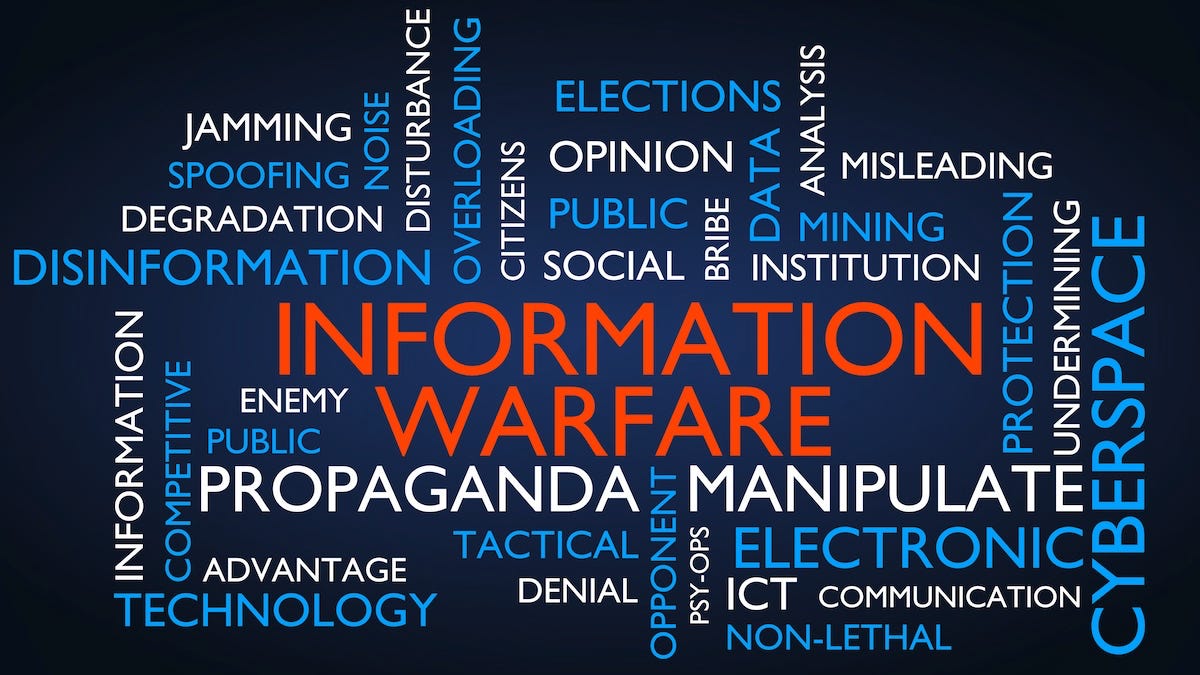
If you’ve ever scrolled through the news and thought, “Wait… why is everyone suddenly arguing about gas stoves?”—congratulations, you may have witnessed a modern information operation.
Propaganda isn’t just about stern faced generals on black and white posters barking orders from behind mustaches. These days, it’s sleek, viral, and sometimes delivered by your favorite meme account. And while you’re debating whether TikTok is brainwashing your kids or just their attention spans, global superpowers are busy waging narrative warfare like it’s a new Olympic sport.
Propaganda and Information Operations (IO) have become core components of statecraft in the 21st century. Nations like the United States, Russia, China, and Iran each integrate influence campaigns into their strategic planning at the highest levels.
This isn’t news to some of you, but the information I’m about to drop in here will probably surprise more than you think.
It is unfolding before our eyes, yet so few of us can see it.
In this piece, we’re peeling back the glossy surface of modern influence operations. We’ll explore how the U.S., Russia, China, Iran, and even Qatar (yes, the World Cup wasn’t just about soccer) use information warfare to shape perception, policy, and public discourse. From military doctrines that treat tweets like tactical assets to media manipulation that would make Orwell throw up in a panic, we’re diving deep.
You’re about to learn why “going viral” might sometimes mean getting caught in someone else’s power play. And most importantly, expect a few chuckles as we unpack 20 years of suspiciously synchronized storylines that may not be as organic as they looked on your feed.
Ready to trace the memes, the bots, and the billion dollar campaigns that make up the global propaganda game? Let’s roll.
Part I: How Countries Strategically Think About Propaganda (Everyone Has a Playbook)
Here’s where we break down the doctrinal approach each major player takes toward propaganda and information operations; not just what they do, but why they do it and how it fits into their national strategy.
Information is no longer just the terrain of media and messaging; it’s an operational domain—one that nations shape, weaponize, and deploy. Whether it’s a viral video or a diplomatic speech, narratives today serve strategic functions, and each country treats that power differently.
This section outlines how the U.S., Russia, China, Iran, and Qatar each fold propaganda and information operations into their national planning—and what that says about their broader strategic identities.
United States: The Great Bureaucracy
The U.S. views information operations through a rules based, compartmentalized lens. Under Joint Publication 3-13, IO is considered a supporting function—something that complements diplomatic and military efforts, not something that leads them. It’s part of the broader DIMEFIL framework, where “Information” has a box to live in, but rarely the starring role.
This cautious approach reflects two core constraints: legal limits on targeting domestic audiences (thanks to the Smith-Mundt Act) and a strong cultural bias toward transparency, even when it’s inconvenient. In practice, U.S. IO efforts focus on military theaters and counter disinformation—responding rather than initiating, correcting rather than shaping. Besides, it’s all so bureaucratic that getting a proposed narrative approved is like trying to talk your way onto a Marine base; it’s possible, but you will need a lot of beer… and crayons.
Soft power remains a major advantage. Hollywood, Silicon Valley, and English language media ecosystems do much of the narrative lifting, often without centralized intent. But when it comes to orchestrated information strategy, the U.S. is more hesitant—deliberate, but rarely quick off the mark.
Russia: The Grandmaster of Narrative Manipulation
Russia takes a fundamentally different view. To Moscow, information isn’t just a tool—it’s a front line. Strategic messaging is built into nearly every aspect of its statecraft, from defense planning to media broadcasting. The goal isn’t always persuasion—it’s often confusion, disruption, and mistrust.
Though the “Gerasimov Doctrine” isn’t formal policy, the idea of using information, cyber, and psychological tools alongside kinetic ones is deeply embedded in Russian military thinking. “Active Measures,” a Soviet era concept, still defines much of how Russia engages the world: create narratives that destabilize, deny responsibility when exposed, and keep adversaries constantly second guessing.
State backed outlets like RT and Sputnik act as global amplifiers, often less interested in promoting Russia than in discrediting its rivals. Meanwhile, troll farms, botnets, and sockpuppet accounts fill in the digital space with noise, alternative facts, and strategic cynicism.
China: The Patient Architect
China’s information doctrine is defined by the “Three Warfares” strategy: Public Opinion, Psychological, and Legal Warfare. It’s less about shock value and more about systemic pressure—slowly redefining the global narrative landscape in ways favorable to Beijing.
The Chinese Communist Party maintains strict control over messaging at home, while expanding its media influence abroad through Xinhua, CGTN, and increasingly, digital platforms like TikTok. Where Russia seeks disruption, China seeks dominance: to shape not just what is said, but what is thinkable within global discourse.
Narratives are carefully coordinated across diplomatic, commercial, and media channels. Key themes—stability, development, win-win cooperation—are repeated with message discipline that borders on scriptwriting. This isn’t about viral spikes; it’s about saturation over time.
And while it’s often subtle, the intended result is no less strategic: increase China’s global legitimacy, isolate criticism, and shift power toward its preferred worldview.
Iran: The Asymmetric Narrator
Iran’s doctrine blends ideology and improvisation. It views information operations as asymmetric tools—low cost, high impact ways to counter technologically superior adversaries. Unlike China’s institutional precision or Russia’s chaos engineering, Iran’s influence campaigns feel more like ideological insurgency.
State media like PressTV, religious networks, and regional proxies serve as both megaphone and echo chamber. Iran’s messages typically focus on anti-Westernism, Islamic resistance, and regional sovereignty—especially in areas where its influence is contested. Its online campaigns often involve cloned news sites, fake personas, and amplification of existing grievances, especially in countries like the U.S. or Saudi Arabia.
Iran doesn’t need to control the conversation—it just needs to insert enough friction to slow its rivals and reinforce its own narrative among sympathetic audiences. It’s storytelling with an edge, designed to provoke, polarize, and reinforce long standing ideological lines.
Qatar: The Soft Power Ninja
Qatar’s approach to influence is built on leverage, not volume. It lacks the military size of its neighbors, but it has capital, credibility (carefully curated, of course), and one of the most influential media platforms in the Middle East: Al Jazeera.
Unlike Russia or China, Qatar doesn’t flood the zone. Its strategy is selective and reputation focused. Al Jazeera balances hard hitting journalism with editorial angles that reflect Doha’s geopolitical interests. This gives it a rare duality: both mainstream legitimacy and subtle influence capability.
Beyond media, Qatar engages in quiet information diplomacy. It sponsors think tanks, cultivates academic partnerships, and promotes global events like the 2022 World Cup to project soft power. Oh, and it has invested over $6 billion in select U.S. universities such as Harvard, Cornell, Carnegie Mellon, and Georgetown to just name a few.
These efforts aren’t about dominating narratives—they’re about curating them, shaping Qatar’s image as modern, independent, and indispensable.
Part II: Strategic Styles Compared
How Nations Tailor Their Influence Operations
Although many countries agree that controlling information is critical to achieving strategic objectives, they approach that task with very different philosophies and tools. Understanding these differences isn’t just academic—it’s essential to recognizing how influence campaigns move through global discourse, how they affect democratic institutions, and how they shape the public narratives we often assume are organic.
This section breaks down five key dimensions where U.S., Russian, Chinese, Iranian, and Qatari information strategies diverge: strategic posture, visibility, tools, tempo, and narrative tone.
Strategic Posture: Who Leads with the Narrative?
Russia and China operate from a fundamentally proactive stance. They don’t wait for an event to happen—they prepare the information space in advance. Russia seeds narratives into the discourse before a military action or political campaign. It introduces just enough ambiguity to create confusion when the real story breaks. China takes a slower, longer view. Its information posture is designed to steadily shape the conversation—not for tomorrow, but for five years from now.
Iran and Qatar take a more situational approach. Iran can respond quickly to crises, particularly those in the Middle East, often leveraging religious or anti-Western framing to mobilize ideological support. Qatar acts opportunistically, building around global events or shifting regional dynamics. Its influence is less about dominance and more about positioning—quietly managing perception through credibility and timing.
The United States tends to be reactive. It often responds to disinformation rather than preemptively shaping the environment. This reflects both legal constraints and a deeply embedded discomfort with “propaganda,” even when other states are using that very discomfort to gain advantage.
Visibility and Deniability: Who Owns Their Narrative?
Russia excels in creating deniability. Even when caught red handed, the objective isn’t to convince you of innocence—it’s to make the truth hard to hold onto. Its narratives come layered in irony, misdirection, and enough digital fog to turn straightforward events into geopolitical mysteries.
China prefers visibility, but with a diplomatic veneer. Its messaging is consistent and centralized, often delivered through official channels like embassies, state media, or affiliated influencers. When challenged, it doubles down with polished counter narratives and legal framing.
Iran uses both visible and invisible channels. PressTV and aligned religious broadcasters carry the overt line, while anonymous accounts and content farms do the dirty work. It prefers plausible proxies—religious, ideological, or otherwise.
Qatar invests in credibility more than concealment. Al Jazeera is a polished, multilingual platform with global reach and editorial sophistication. But its narrative priorities often align closely with Doha’s strategic interests. Its deniability lies not in secrecy, but in ambiguity.
The United States is open about most of its messaging efforts. When U.S. agencies engage in influence campaigns, they typically do so with clear attribution. That transparency builds trust—but also limits flexibility, especially in contested information environments.
Tools and Infrastructure: What’s in the Toolkit?
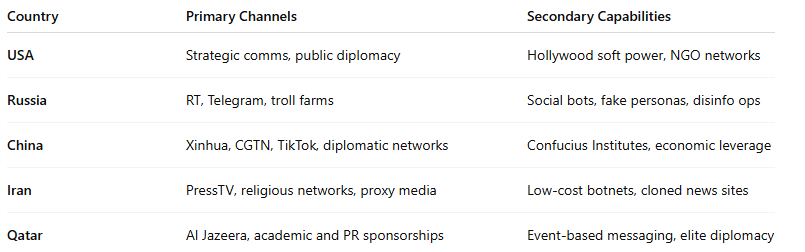
Russia builds networks designed for speed and noise. China invests in structure and scale. Iran focuses on reach through ideology and duplication. Qatar curates. The U.S. depends on institutional messaging—and a soft power machine that often operates independently of the state (and thus outside of its control).
Tempo and Timing: How Fast Do They Move?
Russia moves quickly—particularly during crises. When chaos breaks, it floods the zone with narratives, false leads, and emotionally charged frames. The goal isn’t clarity, but saturation.
China plays the long game. Its campaigns are less about virality and more about narrative accumulation—slow, steady, and deeply embedded.
Iran is more agile than structured. It’s capable of fast, emotionally resonant messaging, especially in response to political conflict or military tension. Its timelines are often calibrated to ideological impact.
Qatar times its moves with precision. Messaging peaks during globally visible moments—the World Cup, peace negotiations, diplomatic flashpoints. Its tempo is quiet but strategic.
The United States follows process driven timelines. Messaging often lags behind the moment. Coordination between agencies, legal vetting, and the risk averse nature of government communication mean speed is not its strength—even when agility is badly needed.
Narrative Tone: What’s the Voice Behind the Message?
Russian messaging is direct, contrarian, and often cynical. It leans heavily on sarcasm, skepticism, and conspiracy to undermine trust in opposing viewpoints. Credibility is not the goal—uncertainty is.
China uses a formal, disciplined tone. Its messaging aims for authority and stability. Public-facing language emphasizes partnership, development, and rational leadership—always positioning China as the calm center in a chaotic world.
Iran adopts a moralistic and ideological voice. It speaks with conviction, rooted in themes of resistance, spiritual legitimacy, and anti-imperialism. Messaging is passionate, sometimes absolutist, and frequently binary.
Qatar presents itself as neutral, informed, and cosmopolitan. Its tone—especially through Al Jazeera—is professional and incisive, designed to appeal to both Arab and Western audiences without sounding overtly political. That balance is part of its strategic identity.
The United States relies on clarity and values-based language. Its public messaging often reflects democratic ideals, appeals to international norms, and leans into transparency. But it can also sound procedural and slow to adjust tone when the information environment shifts rapidly.
Part III: The Pattern Recognition Framework
What Propaganda Actually Looks Like
Doctrine and tools tell you how countries approach information warfare. But to recognize it in the wild—on your feed, in the headlines, across talking points repeated with eerie precision—you need to understand the patterns.
Propaganda today isn’t just shouting a lie until it sticks. It’s about behavioral influence: shaping narratives before you notice, boosting stories for maximum reach, and using digital platforms to simulate grassroots support.
This section outlines the recurring features that define modern propaganda and influence operations—across countries, crises, and platforms.
Narrative Engineering
At the core of every campaign is a simple, repeatable message, often emotionally loaded and tied to identity, fear, or outrage. These narratives are:
Binary: framing issues as good vs. evil, us vs. them.
Sticky: designed to be easily shared, retold, and adapted across formats.
Adaptive: adjusted in real-time based on audience response and platform dynamics.
These aren’t random slogans—they’re engineered to travel. Whether it’s “NATO expansionism,” “Western decline,” “cultural Marxism,” or “clean governance under authoritarianism,” the point is less about accuracy and more about resonance.
Inorganic Amplification
A key feature of modern IO is boosting—pushing content into relevance, often artificially, through:
Botnets and sockpuppets: Coordinated inauthentic accounts that inflate reach or simulate consensus.
Paid amplification: Sponsored posts through proxies or covert influence campaigns.
Hashtag hijacking: Flooding popular conversations with off topic narratives to manipulate attention.
Engagement is the currency of legitimacy online. If a narrative looks like it’s “everywhere,” people tend to believe it has merit—whether it does or not. The goal is to manufacture that visibility quickly and at scale.
Hijacking Real Events
Modern propaganda rarely fabricates events—it reframes them. Natural disasters, protests, elections, or public health emergencies become raw material for narrative insertion. Key techniques include:
Recontextualization: Presenting facts through a filtered ideological lens.
Whataboutism: Deflecting criticism by invoking hypocrisy elsewhere (“Yes, we censor, but look at U.S. police violence”).
Selective outrage: Highlighting specific stories while ignoring or downplaying others to create a sense of systemic failure or bias.
These efforts are particularly effective during crisis windows—when public uncertainty is high, information moves quickly, and fact checking lags behind attention.
Targeting Divides
Every country has fault lines—racial, religious, ideological, economic. Effective IO campaigns exploit those divides. Rather than introducing new ideas, they often amplify existing grievances:
In the U.S., this might mean racial injustice, gun control, or electoral legitimacy.
In Europe, immigration and national identity are frequent targets.
In developing regions, economic inequality and colonial legacy narratives are often deployed.
The tactic is subtle: not to invent conflict, but to intensify it—increasing polarization and eroding consensus. The more fractured the information environment, the less capable societies become at responding coherently.
Platform Optimization
Every campaign is tailored to its medium:
Twitter/X: Short form disruption, bots, trending manipulation.
Facebook: Local community infiltration, long tail sharing.
TikTok/YouTube: Emotional visuals, repetition, music cues, identity signaling.
Telegram and WhatsApp: Encrypted ideological echo chambers with limited moderation.
State actors understand platform culture. Russia thrives in chaos and fringe forums. China leans into polished, platform friendly narratives. Iran and Qatar tailor content to religious, regional, or diasporic audiences—each in their own register.
Strategic Silence
Sometimes, what’s not being said is the most important clue.
Omitting critical stories that might challenge the dominant narrative.
Suppressing coverage of internal failures or dissent.
Amplifying fringe dissent from adversaries while silencing moderates at home.
This is common in Chinese and Qatari messaging—where the goal isn’t just to push a preferred story, but to limit the range of what people are allowed to think about.
Narrative control isn’t always about addition. Sometimes it’s subtraction.
In short, the pattern isn’t defined by one tactic—it’s the consistency across format, timing, and message discipline. When narratives spike without clear cause, appear simultaneously across multiple platforms, avoid factual rebuttals, and engage known emotional triggers—chances are, they didn’t go viral by accident.
Part IV: Case Studies
When Narratives Don’t Act Natural
Not all propaganda looks like propaganda. Sometimes it’s a “viral” video that shows up in every inbox at once. Other times it’s a fringe headline that somehow ends up dominating national debate within hours. This section looks at specific cases—narratives that gained disproportionate traction, showed telltale signs of inorganic amplification, or aligned a little too well with the strategic interests of foreign actors.
These are not always definitive cases of information warfare—but they exhibit enough markers (timing, messaging coordination, engagement anomalies, alignment with foreign objectives) to warrant deeper scrutiny.
The 2016 U.S. Election: Russia’s Narrative Playground
The 2016 U.S. presidential election marked a watershed moment in modern information warfare. Russian influence operations were not merely attempts to support one candidate over another—they were designed to destabilize public trust in democracy itself.
According to U.S. intelligence agencies, the effort was multifaceted and deeply strategic, employing covert and overt tactics across nearly every major social media platform.
Russian trolls—primarily operating out of the Internet Research Agency (IRA)—created thousands of fake personas posing as Americans. These accounts targeted users across the political spectrum, using tailored messaging to amplify division.
Conservative leaning users were fed content focused on immigration, gun rights, and nationalism. Liberal leaning users saw posts emphasizing police brutality, minority rights, and disenfranchisement.
The goal wasn’t persuasion. It was polarization.
State backed media outlets like RT and Sputnik also played a key role by laundering narratives through what appeared to be legitimate news sources. Paid Facebook ads, often bought in rubles, promoted these divisive themes and were seen by millions.
Twitter bots and trolls magnified hashtags, such as #LockHerUp and #NotMyPresident, to heighten tensions regardless of political direction.
Perhaps most telling was the strategic deployment of disinformation in the final weeks of the campaign—such as the promotion of WikiLeaks content combined with conspiracy theories implicating both the Clinton and Trump campaigns in everything from satanic rituals to targeted assassinations.
These weren’t just wild fringe ideas; they were surgically timed and designed to sap voter enthusiasm, increase cynicism, and delegitimize the outcome in advance.
In the end, the operation didn’t just support a candidate—it changed the rules of engagement for modern elections. The battlefield was no longer the ballot box, but the timeline. And Russia proved it could win territory there without firing a shot.
As one intelligence official later put it, “It was like Pearl Harbor, except the bombs were memes.”
COVID-19 Origins and Disinformation Ecosystems
The COVID-19 pandemic was not only a public health emergency (if you call it an emergency when 75% of fatalities had 4 or more comorbidities)—it was a global infodemic. Almost from the outset, foreign actors mobilized to shape the narrative, not just to protect their reputations but to exploit fear, confusion, and political divides in other countries, especially the United States.
China was the first out of the gate. As global attention focused on the Wuhan outbreak, Chinese state media and diplomats began aggressively pushing the counter-narrative that the virus may have originated at the U.S. Army’s Fort Detrick biolab.
The theory gained traction via tweets from official diplomatic accounts, coverage in Global Times, and amplification by aligned influencers. Bot networks helped drive hashtags like #FortDetrick and #USBiolab on Twitter, particularly targeting non-Western audiences. The goal wasn’t necessarily to convince—it was to cloud the waters and create a false moral equivalency.
Meanwhile, Russia unleashed a disinformation ecosystem of its own, focusing primarily on anti-vaccine propaganda and COVID conspiracies. Narratives ranged from claiming the virus was a hoax, to accusing pharmaceutical companies of colluding with Western governments for profit, to amplifying fears about mRNA technology. Content was distributed across Telegram, fringe health websites, and even mainstream social media platforms. According to EU disinfo trackers, Russian linked outlets published hundreds of articles designed to sow doubt about vaccine safety and Western public health responses.
Iran, for its part, blended anti-U.S. messaging with religious overtones—claiming the virus was a bioweapon and a form of divine punishment for Western immorality. Iranian backed social media accounts often echoed conspiracy theories from Russia and China, further muddying the discourse.
The result was an information fog so thick that even credible health messages struggled to cut through. The pandemic was weaponized—not just to deflect blame, but to fracture trust in institutions, science, and even neighbors. It was a masterclass in asymmetric influence: low cost, high impact, and difficult to attribute in real time.
As one analyst joked during a webinar: “If COVID was the fire, disinformation was the gasoline. And Twitter was the match.”
Black Lives Matter Protests and Social Fragmentation
In the summer of 2020, following the murder of George Floyd, the United States saw some of the largest civil rights protests in modern history. But what should have been a moment of national reckoning and dialogue was quickly caught in the gravitational pull of foreign influence operations.
Russia and Iran, in particular, didn’t invent the Black Lives Matter movement—but they were quick to exploit its emotional and polarizing potential.
Russian linked troll accounts posed as both activists and counter protestors, often amplifying incendiary content designed to provoke outrage on both sides. One set of accounts posed as Black activists demanding justice; another posed as far right groups warning of violent mobs. The aim wasn’t to support or undermine a particular position—it was to inflame both simultaneously and stoke the perception of chaos.
Iranian media and social accounts, meanwhile, framed the protests as proof of U.S. hypocrisy on human rights. State backed outlets like Press TV portrayed the unrest as a sign of American collapse and systemic failure, often juxtaposing protest images with footage of U.S. foreign interventions.
The operational tactic was elegant in its simplicity: amplify real grievances, escalate division, and let the internal discourse fracture on its own. The messaging was pushed through bot networks, coordinated hashtag campaigns, and even fabricated videos designed to look like real protest footage.
It was influence by distortion—not telling lies, but magnifying the ugliest truths until they became the only lens through which people viewed each other.
The Gas Stove “Culture War” Flashpoint
In early 2023, a small government report about potential health risks linked to gas stove emissions triggered an outsized public response. What began as a regulatory whisper turned into a cultural scream, with pundits claiming the federal government was coming to rip stoves from suburban kitchens.
Within 48 hours, Twitter was flooded with memes, outrage posts, and declarations of culinary independence.
While the core issue was rooted in indoor air quality studies, foreign aligned bot activity helped turn the discussion into a broader ideological debate. Russia linked accounts framed the issue as government overreach, connecting it to climate mandates and “green tyranny.”
Meanwhile, the narrative gained traction among U.S. influencers who framed the story as a test case for wider culture war engagement.
It was a classic case of narrative hijacking—a scientifically grounded policy debate spun into a tribal identity marker. By the time experts clarified that no one was banning stoves, the narrative had already hardened into belief.
What made this episode notable wasn’t just the overreaction, but the speed and method by which it was amplified, particularly by coordinated accounts using culture as a gateway to political outrage.
Jade Helm 15: Martial Law... in Texas?
In 2015, the U.S. military planned a routine multi state training exercise called Jade Helm 15. Before a single boot hit the ground, conspiracy theories erupted online—claiming the operation was a cover for federal martial law, gun confiscations, or rounding up political dissidents.
Some even insisted Walmarts were being converted into internment camps.
What began as fringe speculation was rapidly amplified through coordinated online activity, including troll accounts linked to Russian disinformation networks. RT and Sputnik gave the theory international airtime, further legitimizing what would have otherwise remained a niche online panic.
Hashtags trended. Facebook groups swelled. Texas talk radio ran with it.
The reaction reached a surreal peak when the Texas governor ordered the State Guard to “monitor” federal troops. The U.S. military was effectively treated like an invading force by its own people—a victory for narrative manipulation, not any real world plot.
The incident revealed how a false story, strategically amplified, could force political action and public fear out of nothing more than digital noise.
Heart of Texas: A Facebook Page with No Texans
Among the most brazen examples of foreign crafted domestic discord was the “Heart of Texas” Facebook page, created by Russia’s Internet Research Agency (IRA). The page masqueraded as a grassroots Texan nationalist movement, calling for secession, promoting anti-Muslim rhetoric, and cloaking itself in a heavy dose of red, white, and blue branding.
At its peak, it amassed over 250,000 followers—more than some legitimate Texas political organizations. The IRA used the page to organize real world events, including one rally at a Houston mosque and a counter protest staged simultaneously through another IRA run page. The two sides, both unwittingly manipulated by foreign operators, confronted each other in person while the instigators watched from across the globe.
The operation demonstrated a striking evolution in disinformation strategy: not just content amplification, but direct orchestration of physical conflict through digital puppetry. The success wasn’t just measured in clicks—it was in bodies on sidewalks responding to fake provocations.
This wasn’t misinformation by mistake—it was manufactured polarization, algorithmically tuned for maximum friction.
Calexit: West Coast Secession, With a Russian Office
In the aftermath of the 2016 presidential election, secessionist sentiment in California—long a fringe idea—suddenly found new momentum under the banner of “Yes California.”
The movement pushed for a referendum on whether the state should break away from the U.S., capitalizing on widespread frustration and polarization.
What set this campaign apart wasn’t its political platform but its logistics: the organization’s leader, Louis Marinelli, was living in Russia and receiving support from a Kremlin linked nationalist think tank. Russian state media enthusiastically covered the campaign, portraying it as a popular grassroots rebellion against Washington’s overreach.
Social media activity around #Calexit spiked disproportionately, with bot accounts and troll farms amplifying the idea as both inevitable and legitimate. The messaging leaned into existing cultural divides—contrasting California’s progressive values with perceived federal dysfunction and authoritarianism.
Though the movement failed to gain legal or political traction, it succeeded in mainstreaming the idea that U.S. fragmentation wasn’t just possible—it was worth considering.
The playbook mirrored that used in European secessionist movements: foster disillusionment, amplify identity differences, and normalize fracture as a form of liberation.
Seth Rich Conspiracy: Misdirection in Plain Sight
The tragic 2016 murder of DNC staffer Seth Rich became the centerpiece of one of the most damaging disinformation campaigns of the election cycle.
Almost immediately, Russian intelligence operatives began spreading the idea that Rich, not Russian hackers, had leaked Democratic emails to WikiLeaks. The implication: there was no foreign interference, just a rogue insider silenced for knowing too much.
The narrative was methodically pushed through online forums, fringe news sites, and eventually gained traction in mainstream outlets. WikiLeaks added fuel by refusing to deny the connection.
Bot networks ensured the story trended, while opportunistic pundits repeated it as plausible counter narrative to the mounting evidence of Russian involvement.
Despite being repeatedly debunked—including by law enforcement and Rich’s own family—the conspiracy endured. Its persistence served a clear strategic function: deflect attention from Moscow, undermine U.S. intelligence agencies, and polarize political discourse.
Rather than denying the hack, Russia simply offered an alternate theory and let the American public fight over it. It was a case study in narrative misdirection: effective, persistent, and cruelly targeted at a grieving family.
Ukraine: Bioweapons Labs Conspiracy
As Russian forces invaded Ukraine in February 2022, the Kremlin didn’t just deploy tanks—it unleashed a narrative war.
Among the most prominent claims: that Russia was targeting U.S. funded biological weapons laboratories hidden across Ukraine. State officials alleged these labs were building pathogens that could target specific ethnic groups—a science fiction plot repurposed for geopolitical justification.
These assertions were quickly amplified across Russian media, echoed by Chinese state outlets, and parroted by a patchwork of conspiracy communities online. Fabricated documents and doctored maps circulated widely, often presented without context as “proof” of a secret American biowarfare program on Russia’s doorstep.
The narrative dovetailed neatly with pre-existing distrust in Western bio research institutions, lingering COVID-19 suspicions, and anti-globalist sentiment. While the U.S. had funded public health labs in Ukraine as part of a longstanding disease surveillance initiative, there was no evidence of military or offensive research.
But as with most influence campaigns, evidence was beside the point. The goal was to legitimize Russian aggression, cast doubt on Western intentions, and fragment public opinion, especially within NATO countries. The messaging was coordinated, strategic, and—for many—plausible enough to slow condemnation or spark distraction.
It was a modern example of wartime propaganda—weaponized not through leaflets or radio broadcasts, but through hashtags and Telegram channels.
The U.S. Created ISIS Narrative
One of the more enduring regional disinformation narratives has been the claim that the United States was responsible for the creation and support of ISIS.
Promoted heavily by Iranian state media and echoed by Russia and some Arab platforms, this narrative has found fertile ground in parts of the Middle East already skeptical of U.S. military intervention.
The theory relies on a mix of selective fact, misinformation, and doctored imagery. Circulated widely were altered photos allegedly showing U.S. politicians—most famously Senator John McCain—meeting with ISIS leaders. These were typically images from visits with vetted Syrian opposition groups, but were relabeled and stripped of context to fit a broader anti-American storyline.
Iranian outlets like Press TV and Al-Alam positioned the narrative as proof of Western duplicity: that ISIS was a manufactured threat designed to destabilize the region, justify American military presence, and undermine Iran’s sphere of influence.
In this version of events, Iran and its proxies are cast as the true defenders of regional stability, while the U.S. is portrayed as the arsonist posing as firefighter.
The impact was twofold: discrediting the U.S. in the eyes of regional audiences, and justifying Iran’s own operations in Iraq and Syria. While no credible evidence has ever surfaced to support the claim, its resonance illustrates how effective repetition and emotional framing can turn fiction into durable political belief.
Common Patterns Across Cases
Across these varied cases—from secessionist plots to pandemic conspiracies—clear patterns emerge that help distinguish organic discourse from strategically manufactured narratives. These operations don’t rely on a single tactic but rather a constellation of psychological and technological levers designed to amplify division, undermine institutions, and reframe truth as subjective.
Rapid Onset and Emotional Framing: Most disinformation campaigns gain visibility quickly, often within hours of an initial post. They tend to exploit emotionally loaded issues—fear, outrage, identity—that short-circuit analytical thinking and drive engagement.
Inorganic Amplification: Sudden spikes in visibility are often accompanied by bot activity or coordinated networks of fake accounts. These actors recycle, repost, and retweet content to create a false sense of popularity or consensus. Engagement metrics are gamed to shape algorithms.
Weaponized Ambiguity: Rather than promoting a clear message, many of these narratives aim to confuse or cast doubt. The goal is often not to convince the audience of one truth, but to overwhelm them with conflicting versions of reality — eroding the very idea of objective fact.
Exploitation of Existing Divides: None of these campaigns create tension from scratch. Instead, they identify existing social, political, or cultural rifts — and widen them. Race, religion, class, and geography become terrain for influence, not just context.
Alignment with Foreign Policy Objectives: Each narrative ultimately serves a foreign strategic interest, whether it’s shielding an ally, discrediting an adversary, or weakening a democratic competitor. Even when the messaging appears domestic, the beneficiaries are often external.
Real World Consequences: These aren’t just online games. Many of these stories prompt political action, shape public health behavior, or escalate tensions in the street. They have moved seamlessly from the digital sphere into tangible impacts.
Together, these patterns form a playbook. While tactics evolve, the strategic logic remains consistent: manipulate perception at scale, through narratives that travel faster than fact checking ever will.
Conclusion: Know the Game, Not Just the Players
The landscape of influence is no longer limited to leaflets, speeches, or even overt propaganda.
It now lives in our feeds, our group chats, our recommendations—algorithmically delivered and emotionally engineered.
Foreign information operations aren’t always trying to convince you of a lie; often, they just want to exhaust you, confuse you, and fracture consensus until truth becomes optional.
Across dozens of case studies, we’ve seen how different actors—Russia, China, Iran, Qatar—adapt influence to their strategic cultures. Some aim to dominate the narrative; others aim to drown it in noise. Some create stories; others simply amplify the worst of what’s already there. But the common goal remains the same: strategic advantage without direct confrontation.
In the U.S., where openness and free expression are fundamental values, resilience doesn’t come from censorship—it comes from awareness. Recognizing the signs, understanding the strategies, and building cultural immunity to manipulation are the best defenses in an era where attention is the battlefield.
This report isn’t meant to induce paranoia. It’s meant to sharpen perception. Influence is a permanent fixture of geopolitics—but so is the ability to see through it.
Stay curious. Stay skeptical. And maybe think twice before resharing that viral tweet about gas stoves and martial law.
Question everything.
DOL
Goodness Brother. This is an excellent and inspiring piece of work here that I am just getting started on and realizing the depth and importance of your effort. Highly impressed and one in which I will be studying on for some time.
Fabulous job, Green Beret !!!