
Qatar’s Quiet Makeover
How Doha’s Dollars Infiltrated Conservative Media

I nearly spit out my coffee when I saw Tucker Carlson fawning over Qatar’s prime minister on his show earlier this year. Carlson, a previous icon of America First conservatism, suddenly praising a tiny Gulf emirate known for its ties to Hamas?
What gives?
As it turns out, if you follow the money (all hundreds of millions of it), things start making sense. Over the past five years, Qatar has poured an eye popping amount of cash into U.S. influence operations, greasing media outlets, cozying up to politicians, and subtly shifting narratives in its favor. The result? A strange new MAGA world where some conservative voices sound more pro-Doha and anti-Israel than anyone would’ve imagined a few years ago.
There have always been anti-Semites, of course. This is not a new thing. But, you have to admit, their noisiness has grown in the last five years.
And… they’ve attached a few big names to their cause.
Though, before we get started, I wanted to just give a bit about my background and some of the most fascinating training I have received and conducted. Before leaving the Army, my last job was managing an irregular warfare planning course that focused on operational to strategic level planning.
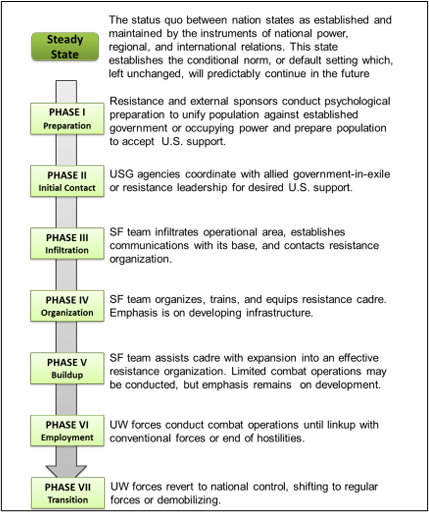
This process addresses theater level problems through a DIMEFIL framework, leveraging Operational Design and Course of Action (COA) development to establish coherent Lines of Effort that align with the phases of Unconventional Warfare (UW) as structured within the Joint Planning Process (JPP).
Throughout this process, Information Operations (IO)—encompassing the integrated employment of information related capabilities such as Military Information Support Operations (MISO), Public Affairs, Cyberspace Operations, and Civil-Military Operations—are synchronized across all phases to shape the information environment, influence target audiences, and protect friendly narratives in support of operational objectives.
Yes, that is all doctrinal.
It was by far my favorite course and job in the Army. So, just know that when I do these write ups, I do them on my own time and because I understand how the strategic and operational levels move from all of these different perspectives while most people simply do not.
From Obama to Biden: How Two Administrations Helped Rehab Qatar’s Image
Qatar’s U.S. makeover didn’t start with MAGA world—it started under Obama. During the Arab Spring, the Obama administration leaned heavily on Doha as a regional fixer, despite mounting concerns that Qatar was funding Islamist factions, including the Muslim Brotherhood and Hamas.
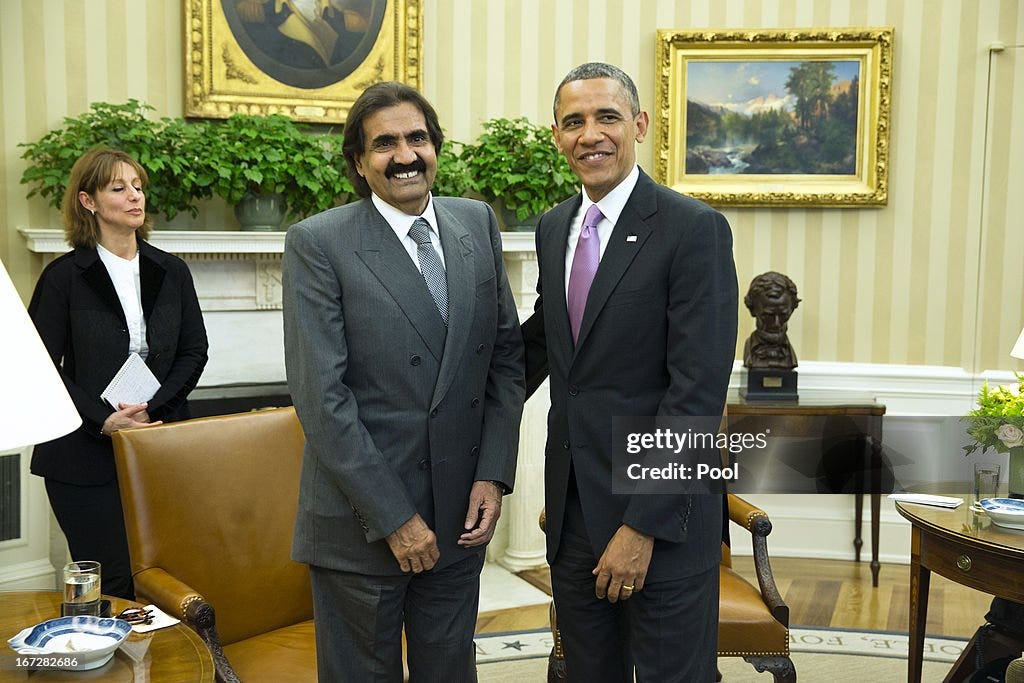
Emails later revealed that top Obama officials—including Hillary Clinton’s team—routinely coordinated with Qatari diplomats and intermediaries, treating them as “go-betweens” in Syria, Egypt, and Gaza, even as Qatar quietly funneled money to Salafi militias and Hamas leadership operating openly in Doha.
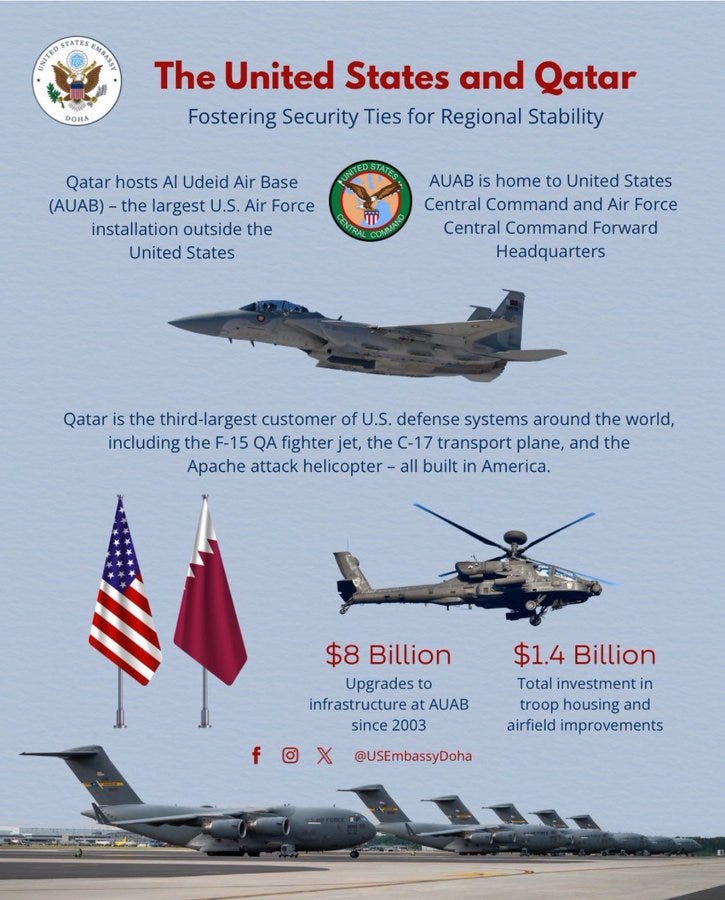
Fast forward to the Biden era, and that partnership only deepened. In January 2022, President Biden designated Qatar a Major Non-NATO Ally (MNNA)—a strategic label shared with countries like Israel, Japan, and Australia. This gave Qatar preferred access to U.S. military technology, joint exercises, and arms sales, effectively formalizing the relationship just months before the World Cup and while Qatar was actively mediating between Hamas and Israel.
That same year, Qatar’s Emir Tamim bin Hamad Al Thani visited the White House—the first Gulf leader to do so under Biden—and walked away with multi billion dollar LNG export approvals and robust defense deals.
The White House lauded Qatar as a “reliable partner,” and Biden personally thanked the Emir for his role in evacuating Americans from Afghanistan (Qatar had hosted Taliban negotiations for years at U.S. request, despite giving Taliban leaders safe harbor in five star Doha hotels).
Meanwhile, alumni of the Obama-Biden foreign policy machine quietly cashed in. Firms like WestExec Advisors, co-founded by former Obama officials (many of whom joined Biden’s cabinet), had clients with commercial and diplomatic ties to Qatar.
Obama’s former defense secretary Ash Carter joined the Qatar based World Innovation Summit for Education (WISE) board, while Kerry linked networks worked closely with Qatari think tank donors on “climate diplomacy.”

In 2015, Obama’s State Department even helped facilitate Qatari gifts to U.S. universities—including nearly $1.4 billion in disclosed donations over two decades, the largest of any foreign donor to U.S. higher education.
And just like in the Trump era, former officials crossed over into direct lobbying. The Qatari government hired former U.S. Attorney General John Ashcroft, and Obama-era diplomats like Amb. Dana Shell Smith transitioned into advisory roles with Qatar Foundation linked groups.
Qatar didn’t just capture one wing of American politics—it played both sides masterfully.
Under Obama and Biden, it was normalized and legitimized. Under Trump, it was privatized and monetized. And by 2025, Doha had woven itself so deeply into Washington’s policy, media, and business circles that few dared call it what it was: a state sponsor of soft power manipulation—and a master of the long game.
