
Iran’s Quiet War
What OSINT Says About Unconventional Warfare Beneath the Surface

I. Introduction: The War Everyone Can See, and the War Most People Are Missing
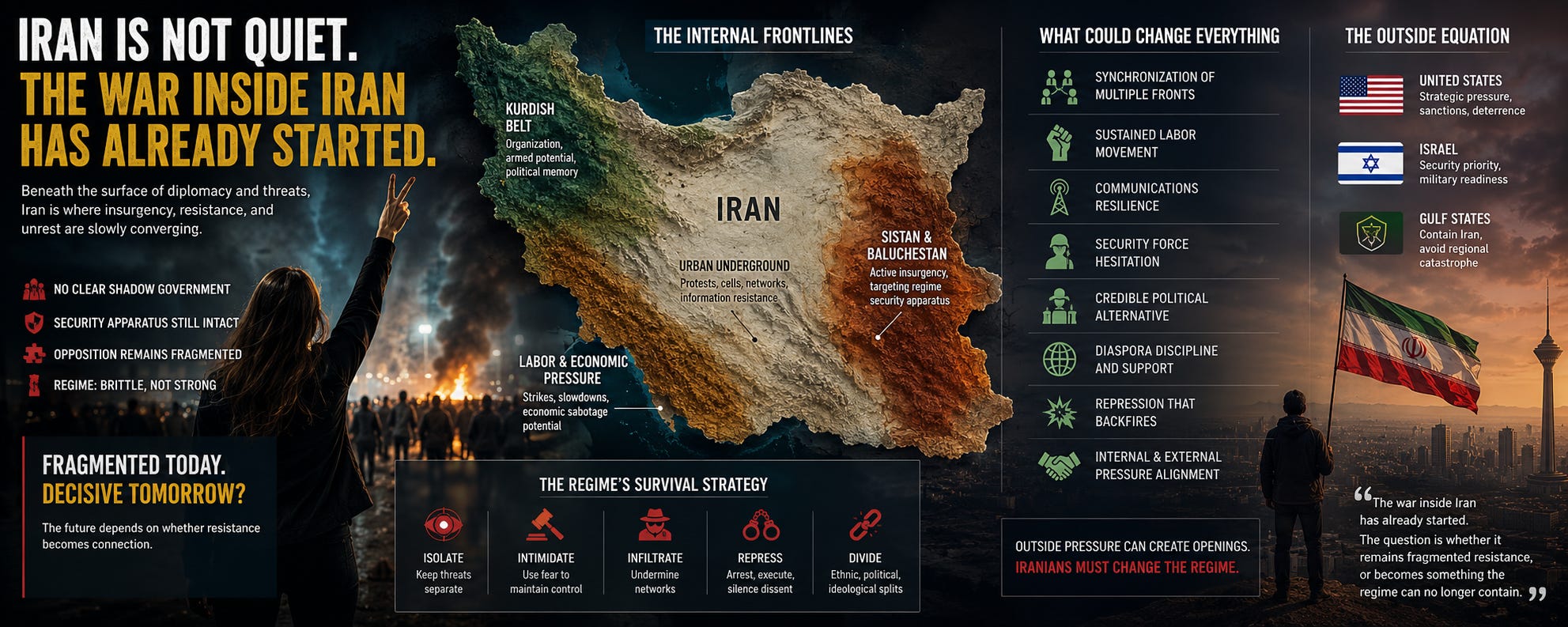
Everyone is watching the skies over Iran.
They are watching for missiles, airstrikes, drone launches, air defense failures, nuclear sites, naval movements, and the next public statement from Washington, Jerusalem, Riyadh, or Tehran. They are watching the visible war because visible war is easier to understand. Aircraft take off. Targets are struck. Buildings burn. Leaders issue warnings. Markets react. Cable news builds maps with arrows on them and calls it analysis.
But the most important fight over Iran’s future may not be happening in the sky.
It may be happening in the seams of the regime.
That is where authoritarian states usually begin to break. Not all at once. Not because one bomb lands in the right place. And certainly not because one speech inspires an entire nation to rise up overnight.
Regimes like Iran survive through layers: fear, surveillance, patronage, ideology, intelligence services, neighborhood informants, loyal security forces, prisons, courts, militias, and the careful belief that resistance is futile. They collapse when those layers begin to separate from one another.
That is the part of the Iran story most people are missing.
The question is not simply whether President Trump, Israel, or the Gulf States are willing to strike Iran again. The better question is whether Iran’s internal resistance is ready to make the next strike matter.
Airpower can destroy infrastructure. It can punish commanders. It can degrade nuclear facilities, missile sites, radar systems, and IRGC nodes.
But airpower alone rarely produces political collapse. For that, the pressure outside the regime has to connect with pressure inside the regime.
That is where unconventional warfare enters the picture.
Unconventional warfare is not just rebels with rifles hiding in the mountains. It is not just sabotage, protests, propaganda, or foreign intelligence support. It is the organized effort to weaken, divide, and eventually break a hostile regime by enabling resistance from within.
Sometimes that resistance is armed. Sometimes it is political. Sometimes it is underground and invisible until the moment it is not. The point is not chaos for the sake of chaos. The point is to turn a regime’s own internal fractures into strategic pressure.
Iran already has fractures.
It has ethnic and sectarian tension in the border regions.
It has a young population that has repeatedly shown it is willing to challenge clerical rule.
It has women who have become symbols of national defiance.
It has labor unrest, economic exhaustion, corruption, currency pressure, and a legitimacy crisis that cannot be solved by another speech from the Supreme Leader.
It has armed resistance in places like Sistan and Baluchestan.
It has Kurdish opposition networks in the northwest.
It has diaspora groups, hackers, activists, and information channels constantly probing for weakness.
But having fractures is not the same as having a revolution.
It is important to understand that. Iran is not yet in a clean, nationwide insurgency; at least not from what we can see overtly. There is no clear shadow government commanding the loyalty of the opposition inside the country. There is no unified national resistance front visibly coordinating armed groups, urban protest networks, labor strikes, and political leadership.
The regime’s security architecture still works. The IRGC, Basij, intelligence services, police, courts, and prisons remain dangerous, loyal enough, and capable of punishing dissent.
So Iran is not stable. But it is also not yet broken.
It sits in the space between fear and rupture. That is the space unconventional warfare lives in. It is the preparation space. The shaping space. The quiet war before the loud one.
The place where underground networks are built, auxiliary support is tested, communications are hardened, confidence targets are struck, opposition factions feel each other out, and outside powers decide whether the internal resistance is strong enough to justify another turn of the wheel.
That may explain the current pause better than the usual political commentary does.
On the surface, the pause looks like diplomacy, restraint, hesitation, or strategic patience. It may be all of those things. But through a UW lens, it also looks like timing. If Trump, Israel, and the Gulf States strike too early, they may damage the Iranian regime without creating the conditions for political change.
If they wait too long, Tehran may use the breathing room to crush underground networks before they mature. But if the timing is right, the next external strike would not just be about destroying targets. It would be about creating space for Iranians already fighting beneath the surface.
That is the real question.
Not whether Iran can be hit.
It can.
The question is whether Iran’s internal resistance is ready to move when it happens.
Author’s Note: This piece is long, but that is because the UW enviornement inside of Iran is complex, fragmented, and clandestine. The intent for this piece is to explain the UW process that I believe is unfolding in Iran currently based off of available Open Source Intelligence. Thank you for your interest in this article; I hope it successfully relays why I believe the US, Israel, and the Gulf States are all in coordination with this current pause.
II. Iran Is Not in Civil War, But It Is Not Stable Either
The first mistake people make when looking at Iran is trying to force it into a category that feels familiar.
They want it to be a revolution, a civil war, a protest movement, a proxy war, a counterterrorism problem, or a nuclear crisis. The truth is that Iran is all of those things in pieces, but none of them completely. That is what makes the situation so dangerous. It does not fit neatly into the boxes policymakers, journalists, and cable news analysts prefer to use.
Iran is not Syria in 2012. It is not Iraq in 2006. It is not Libya before the fall of Qaddafi. There are no large liberated zones inside the country. There is no national insurgent army holding terrain. There is no recognized opposition government administering population centers. There has not been a visible cascade of military defections. Tehran has not lost control of the capital, the major cities, or the core institutions of the state.
All of that information matters.
A regime can be hated and still remain in control. A population can be angry and still be unable to organize. Armed attacks can happen without becoming a national insurgency. Protests can shake a government without toppling it. Iran lives in that uncomfortable middle ground, where the regime is wounded but not collapsing, and the opposition is real but not yet unified.
That middle ground is where serious analysis has to begin.
The Iranian regime still controls the formal instruments of power. The Supreme Leader remains in place. The Islamic Revolutionary Guard Corps remains the backbone of the system. The Basij still gives the regime reach down into neighborhoods, universities, workplaces, and religious communities. The intelligence services still arrest, intimidate, infiltrate, and disappear people. The courts still convert dissent into prison sentences or death sentences. The state still has the ability to shut down communications, flood the streets with security forces, and punish families for the actions of their sons and daughters.
That is not a broken state.
But it is also not a healthy one.
Healthy regimes do not need that much fear to survive. They do not need to beat schoolgirls, execute protesters, shut down the internet, imprison journalists, and send security forces into the streets every time the population finds its voice. They do not need to treat hair, music, labor strikes, university campuses, and funerals as national security threats.
Iran’s government still has power, but much of that power is coercive. It can compel obedience. It cannot manufacture legitimacy.
Obedience is what people give when they are afraid. Legitimacy is what people give when they believe the system has a right to rule. Iran still has obedience in many places. It has loyalty in some. But its legitimacy is badly damaged, especially among the young, urban populations, women, ethnic minorities, labor networks, and families who have watched the regime turn ordinary dissent into a security crisis.
This is why Iran should be understood as a hybrid internal conflict environment.
In the southeast, there is an active localized insurgency among Baluch militant networks that have repeatedly targeted security forces and symbols of state authority. In the northwest, Kurdish opposition groups maintain political and militant structures that continue to challenge Tehran, even if they have not developed into a decisive internal front. In the cities, protest networks, student groups, labor elements, women led resistance, online activists, hackers, and diaspora information channels create persistent pressure against the regime.
None of these pieces alone is enough to break the Islamic Republic. Together, they create an environment the regime cannot fully pacify.
That does not mean collapse is imminent.
It means the regime has to spend more energy maintaining control than it used to. It has to watch more places, arrest more people, censor more information, and prepare for more triggers. A death in custody can become a national protest movement. A strike can become political. A border attack can become a symbol. A funeral can become a rally. A hacked broadcast can become a psychological blow.
In a stable country, these events remain isolated. In an unstable authoritarian system, they begin to echo.
Iran is in that echo chamber now.
The regime still has the guns, prisons, money, institutions, and foreign networks. The opposition has grievance, courage, numbers, diaspora support, and enough armed activity on the margins to matter.
What it does not yet have is synchronization.
The Baluch fight is not fully synchronized with the Kurdish fight. The Kurdish fight is not fully synchronized with urban protest networks. Urban protest networks are not fully synchronized with labor, clerical dissent, exile politics, or a credible transition authority.
The anger is national. The organization is still fragmented.
That fragmentation is one of Tehran’s greatest advantages.
The regime does not need to convince every Iranian that the Islamic Republic is worth saving. It only needs to prevent the people who want change from becoming one movement. It can isolate ethnic minorities from urban Persians. It can portray armed groups as foreign backed terrorists. It can use nationalism to rally people against outside attack. It can divide monarchists, republicans, liberals, leftists, ethnic parties, religious dissidents, and diaspora figures against each other. It can let the opposition argue over the future while the regime controls the present.
That is why describing Iran as either “stable” or “on the verge of collapse” misses the point.
Iran is neither.
It is brittle. It is pressured. It is internally contested. It has localized insurgency, national dissent, deep legitimacy problems, and a security apparatus that still functions.
That is the key tension. The regime is strong enough to survive the moment, but weak enough that every new shock matters. Every strike, sanction, protest, assassination, cyberattack, economic crisis, or regional humiliation lands on a system already carrying too much weight.
This is the strategic space before a decisive phase.
Not peace. Not civil war. Not revolution. Not normal politics.
A pressure cooker.
And from a UW perspective, that is exactly the kind of environment outside powers watch closely. Because the question is not whether people are angry. They are. The question is whether anger can become organization, whether organization can become resistance, and whether resistance can become a political force capable of surviving the morning after the regime begins to crack.
III. The UW Lens: How to Read Iran Without Getting Lost in Headlines
To understand what is happening in Iran, you have to stop reading every event as a separate headline.
A protest is not just a protest. A courthouse attack is not just a courthouse attack. A hacked broadcast is not just a cyber incident. A strike by workers, a funeral that turns political, a border clash, an internet blackout, a women led demonstration, or an IRGC convoy getting hit in the southeast all have to be placed into a larger framework.
Alone, each event can look isolated. Together, they may reveal whether a resistance movement is starting to mature.
That framework is unconventional warfare.
UW is one of those terms that sounds more complicated than it needs to be. At its core, unconventional warfare is the use of internal resistance to pressure, weaken, or overthrow a hostile regime.
It is not simply foreign commandos running around in the dark. It is not just guerrillas with rifles. It is not just sabotage or propaganda. Those can all be pieces of it, but UW is really about turning a regime’s internal vulnerabilities into organized political and military pressure.
The key word is organized.
That is what separates anger from insurgency. Every authoritarian state has angry people. Every corrupt government has citizens who hate it. Every brutal regime produces victims, martyrs, and exiles. But anger by itself does not topple a state.
Anger has to become networks. Networks have to become organization. Organization has to become capability. Capability has to become pressure. And pressure has to become political direction.
Without that progression, a regime can survive almost anything.
It can survive protests. It can survive sanctions. It can survive airstrikes. It can even survive isolated armed attacks.
What it struggles to survive is synchronized pressure: urban unrest, labor disruption, ethnic insurgency, information operations, economic stress, elite defections, external military pressure, and a credible political alternative all hitting at once.
That is when a regime starts to lose the ability to decide where the emergency is.
Iran is not there yet.
But some of the pieces are visible.
The first piece is grievance. Iran has no shortage of it. Economic exhaustion, corruption, clerical rule, gender repression, ethnic discrimination, political imprisonment, regime violence, and the constant gap between the wealth of the ruling elite and the lives of ordinary Iranians all create fertile ground for resistance.
Grievance is the fuel. It does not guarantee action, but without it there is no movement to build on.
The second piece is the underground. This is the part most outsiders never see clearly. The underground is the hidden structure of a resistance movement. It is made up of organizers, communicators, couriers, safe house providers, clandestine media cells, hackers, financiers, local coordinators, and people who keep the movement alive when the streets go quiet.
In Iran, some form of underground almost certainly exists. You do not get repeated protest waves, persistent anti-regime messaging, cyber disruptions, and localized armed activity without hidden networks sustaining them.
But the real question is not whether an underground exists.
The question is whether it is coordinated.
A thousand brave people acting separately are vulnerable. A thousand brave people tied into a secure network are a threat. That is the difference Tehran cares about. The regime can arrest individuals, beat protesters, intimidate families, and shut down neighborhoods.
It becomes much harder when the movement has depth, redundancy, discipline, and the ability to keep functioning after leaders are taken off the board.
The third piece is the auxiliary. In UW terms, the auxiliary is the population support system around the underground. These are not necessarily fighters.
Most never pick up a weapon.
They are the people who hide activists, pass messages, provide money, move supplies, share intelligence, shelter families, document regime abuse, or simply refuse to cooperate when the state demands obedience. A resistance movement cannot survive on fighters alone. It survives because ordinary people quietly make the regime’s job harder.
Iran likely has auxiliary networks in pockets.
The problem is that pockets are not the same as national alignment. Baluch communities may support Baluch resistance for reasons that do not perfectly overlap with urban student movements in Tehran. Kurdish opposition networks may have different goals than Persian monarchists or secular republicans. Labor organizers may want a different future than diaspora political figures. Women led resistance may be the moral center of the movement, but moral authority does not automatically create command and control.
The Iranian opposition is broad, but breadth is not the same as unity.
The fourth piece is armed capability.
This is where the border regions matter. In Sistan and Baluchestan, armed resistance has demonstrated the ability to hit regime linked targets. In the Kurdish northwest, opposition groups have organization, history, and militant experience, though they remain constrained.
These fronts matter because they show that not all resistance in Iran is symbolic or political. Some of it is violent, organized, and persistent.
But armed capability alone is not enough.
An insurgency can fight for years and still remain geographically isolated. A militant group can hit police stations and convoys without becoming a national revolutionary force.
That is the trap analysts have to avoid.
Every armed attack is not a sign that the regime is falling. Sometimes it is just proof that the regime has an unresolved peripheral insurgency. The question is whether those attacks begin to connect with a broader national movement.
That is what synchronization would look like.
If a border attack happens at the same time as urban protests, labor strikes, cyber disruptions, elite defections, and coordinated messaging from a credible political opposition, then the situation changes. The regime would no longer be dealing with separate problems. It would be dealing with a campaign. That is the line between unrest and something much more dangerous.
The fifth piece is political leadership.
This may be the weakest part of the Iranian resistance picture right now. There are leaders, symbols, parties, exile organizations, activists, and influential voices. But there does not appear to be a single accepted political authority capable of speaking for the movement inside the country.
That is important because tearing down a regime is only half the problem. The harder question is who replaces it, who gives orders, who prevents chaos, who negotiates with security forces, and who convinces ordinary people that the morning after will be better than the night before.
This is why shadow governance matters.
A true shadow government is not just a website, a press conference, or a diaspora coalition. It is a parallel political structure with enough legitimacy and reach to administer, coordinate, and represent the resistance.
It gives fence sitters a place to go. It gives defectors someone to contact. It gives outside powers a partner. It gives the population a picture of what comes next.
Iran does not appear to have that yet.
That is one reason the regime still benefits from uncertainty. Many Iranians may hate the Islamic Republic, but fear what could follow if it collapses without order. That fear is not irrational.
People have watched Iraq, Syria, Libya, and Afghanistan. They know that regime collapse can produce freedom, but it can also produce militias, revenge killings, foreign interference, economic collapse, and years of instability.
Tehran exploits that fear constantly. It tells the population that the choice is not between dictatorship and freedom, but between dictatorship and chaos.
A mature UW campaign has to break that argument.
It has to make the regime look weak and the alternative look real. It has to show that resistance is not suicide, that organization exists, that support is broad, that the security forces are not invincible, and that the day after has a plan.
Until then, most people will watch, wait, and quietly calculate risk. That calculation is not cowardice. It is survival.
This is why Iran’s current phase is so important.
The regime is trying to keep every pocket of resistance isolated. The opposition is trying, whether deliberately or instinctively, to connect them. Outside powers are watching to see whether those connections become strong enough to matter.
If they do not, then even another round of strikes may only produce damage, outrage, and temporary disruption. If they do, then external pressure could land on a regime already cracking from within.
That is the UW lens.
Do not ask only whether Iran is angry. It is.
Do not ask only whether the regime can be hit. It can.
Ask whether the anger is becoming organization. Ask whether organization is becoming capability. Ask whether capability is becoming synchronized pressure. Ask whether the population believes resistance can survive. Ask whether the regime’s own enforcers still believe the system is worth bleeding for.
Those are the questions that tell us where Iran really is.
IV. The First Real Front: Sistan and Baluchestan
If you are looking for the clearest insurgency indicators inside Iran, you do not start in Tehran.
You start in Sistan and Baluchestan.
That does not mean Tehran is unimportant. Tehran is the political center of gravity. It is where the regime’s legitimacy would ultimately be tested, where elite fractures would matter most, and where any true national transition would have to become visible.
But from a UW perspective, the southeast is where the armed resistance picture is clearest. It is the place where grievance, geography, identity, state repression, and militant capability overlap in a way that looks less like ordinary dissent and more like a persistent insurgent problem.
Sistan and Baluchestan sits on Iran’s southeastern edge, bordering Pakistan and Afghanistan. That geography is immensely important. Borderlands are difficult for centralized regimes to fully control.
They provide smuggling routes, tribal and family networks, sanctuary opportunities, weapons flows, and cross border depth. They also tend to produce populations that feel neglected by the capital and abused by security forces.
In this case, the province is home to many Sunni Baluch in a Shiite Persian dominated state, and that ethnic and sectarian divide gives the conflict a deeper emotional and political charge.
This is not a new problem for Tehran.
The Iranian state has faced years of unrest, militancy, and security force clashes in the province. Jaish al-Adl, a Sunni Baluch militant group, has repeatedly targeted Iranian police, border guards, and IRGC linked positions. Iranian officials call the group terrorist. The group presents itself as defending the rights of the Baluch population against regime repression.
Those two descriptions are not mutually exclusive in the real world of insurgency. A movement can use terrorism, exploit legitimate grievance, and still draw oxygen from real state abuse.
That is why this front matters.
The violence in Sistan and Baluchestan is not just criminality or random extremism. It is connected to a broader political environment where a marginalized population has deep grievances against the state, where security forces are seen by many locals as occupiers rather than protectors, and where armed groups have demonstrated the ability to hit regime targets.
In July 2025, gunmen attacked a courthouse in Zahedan, killing at least six people and wounding around twenty more, according to reporting from the Associated Press and The Guardian. Iranian linked reporting attributed the attack to Jaish al-Adl, and the attackers reportedly used firearms and grenades before security forces killed three of them.
A courthouse is not just a building.
In a place like Sistan and Baluchestan, it is a symbol of regime power. It represents the state’s ability to arrest, judge, imprison, and execute. When militants attack a court building, they are not merely trying to create casualties. They are attacking the image of state control. They are telling the population that the regime can be reached. They are telling local security forces that they are vulnerable. They are telling Tehran that the province is not pacified.
In UW terms, that is what makes it a confidence target.
A confidence target is selected not only for tactical effect, but for psychological effect. The point is to build confidence among supporters, shake confidence among regime loyalists, and force undecided locals to reconsider who actually controls the environment.
A successful attack does not have to destroy the state. It only has to make the state look mortal. That is how insurgencies begin to alter the emotional terrain of a conflict.
The same pattern shows up in attacks against police and security forces.
In October 2024, at least ten Iranian police officers were killed in an ambush in the same province, another incident tied in open reporting to the persistent violence in Sistan and Baluchestan.
The Associated Press also reported that Iranian security forces later killed thirteen militants in separate operations in the province, with Iranian state television saying several of those militants were linked to the killing of police officers. That cycle is important: insurgent attack, regime raid, arrests, more resentment, more security presence, more opportunity for militant recruitment.
That is the rhythm of a low grade insurgency.
The regime hits the network. The network hits back. The population is squeezed in between. Every checkpoint, raid, funeral, arrest, and accidental killing becomes part of the political story.
Tehran can call it counterterrorism. The militants can call it resistance.
Locals may see elements of both depending on who was killed, who was arrested, and how the security forces behaved afterward.
This is where governments often misread the battlefield.
They count bodies and assume they are winning. They kill militants and announce the network has been dismantled. They flood the area with security forces and call it stabilization.
But insurgency is not measured only by how many fighters are killed. It is measured by whether the grievance survives, whether the population continues to provide passive support, whether replacement fighters emerge, whether intelligence dries up, and whether the state’s presence becomes more feared than respected.
By that standard, Sistan and Baluchestan remains a real problem for Tehran.
It is also the one part of Iran where the auxiliary question becomes sharper. In UW terms, the auxiliary is the support structure around the underground and armed elements.
It is the family that hides someone for a night. The cousin who passes a warning. The shopkeeper who notices unfamiliar security vehicles. The driver who moves a package without asking too many questions. The local cleric who shapes opinion. The teenager with a phone who records the aftermath of a raid. The population does not have to openly join the insurgency to make the regime’s job harder.
There are strong reasons to believe some auxiliary support exists in the southeast.
You do not sustain repeated militant activity in a heavily policed province without some combination of local knowledge, cross border facilitation, intimidation, ideological support, family networks, or passive tolerance.
That does not mean the entire Baluch population supports Jaish al-Adl. It almost certainly does not. It also does not mean every act of violence is popular. Civilian casualties can backfire, and militant groups can alienate the very population they claim to defend.
But the persistence of the violence suggests the regime has not fully penetrated or neutralized the environment.
That is a meaningful UW indicator.
Still, this front has limits.
Sistan and Baluchestan is not enough to topple the Islamic Republic by itself. The province is geographically distant from the regime’s core. Its ethnic and sectarian identity can make it easier for Tehran to isolate the conflict from the Persian urban majority.
The regime can portray Baluch militants as separatists, foreign backed extremists, or terrorists, and many Iranians outside the region may accept that framing even if they dislike the regime. That is one of Tehran’s most effective defensive tools: keep each grievance trapped inside its own identity box.
So the question is not whether there is an insurgency in the southeast.
There is enough open source evidence to say there is a persistent localized insurgency or insurgent environment. The real question is whether that fight can connect to the broader anti-regime struggle.
If the Baluch front remains isolated, Tehran can manage it as a peripheral security problem. It can surge forces, conduct raids, pressure Pakistan, execute suspects, and control the narrative. But if Baluch armed pressure begins to synchronize with Kurdish activity, urban unrest, labor strikes, cyber disruption, and elite fractures, then it becomes something much more dangerous.
That is the difference between a local insurgency and a national UW campaign.
Right now, Sistan and Baluchestan looks like Iran’s most mature armed resistance front, but not yet the engine of nationwide collapse. It shows that the regime can be hit. It shows that some armed networks retain capability. It shows that Tehran does not have uncontested control in every province. It also shows the limits of fragmentation.
A courthouse attack in Zahedan can embarrass the regime, inspire militants, and terrify local officials, but it does not automatically move students in Tehran, workers in Ahvaz, merchants in Isfahan, or soldiers inside the IRGC.
That is why synchronization is the word to watch.
If future attacks in the southeast remain isolated, they will continue to bleed the regime at the margins. If they begin to align with a wider resistance architecture, they could help stretch the security apparatus at the exact moment outside pressure increases.
That is when the province stops being a peripheral insurgency and becomes part of a strategic campaign.
For now, Sistan and Baluchestan is the first real front.
Not because it can defeat Tehran alone.
Because it proves the regime’s monopoly on violence is already contested.
V. The Kurdish Belt: Organized, Armed, But Still Constrained
The second major pressure point sits in Iran’s northwest.
This is the Kurdish belt.
If Sistan and Baluchestan gives us the clearest picture of localized armed insurgency, the Kurdish northwest gives us a different but equally important piece of the UW puzzle: organization, identity, history, and political memory.
Kurdish opposition to Tehran is not new. It did not begin with the latest protest wave, the latest Israeli strike, the latest American threat, or the latest round of sanctions. It is older, deeper, and more structurally rooted than most outside observers understand.
That matters because insurgencies do not come from nowhere.
They are built out of memory. They are built out of grievance passed from one generation to the next. They are built out of families who remember executions, villages that remember raids, parties that remember betrayals, and communities that believe the state has never represented them.
For Kurdish opposition groups, the Islamic Republic is not just a bad government. It is a state that has repeatedly denied political autonomy, suppressed identity, targeted dissidents, and treated Kurdish organization as a security threat.
That gives the Kurdish front a different character than the urban protest movement.
Urban protest movements can erupt quickly. They can spread fast, especially when a single event becomes a national symbol. The death of Mahsa Amini showed that clearly.
Her death did not create Iran’s legitimacy crisis, but it lit a match in a country already soaked in fuel. The slogan “Woman, Life, Freedom” moved from Kurdish regions into the national bloodstream because it touched something broader than ethnicity.
It became a language of defiance.
But Kurdish resistance also has something street protests often lack.
It has structure.
There are Kurdish political parties, armed wings, exile networks, veteran cadres, media channels, diaspora support, and experience operating under state pressure. That does not make them decisive. It does not mean they can march on Tehran. It does not mean they are unified among themselves.
But it does mean the Kurdish theater contains preexisting political and militant infrastructure that could matter if Iran’s internal crisis deepens.
From a UW perspective, that is important to understand.
A resistance movement does not only need anger. It needs people who know how to organize. It needs people who understand clandestine communication, safe movement, recruitment, messaging, survival under surveillance, and the relationship between political activity and armed pressure.
Kurdish opposition networks have more of that experience than many other parts of the Iranian opposition. That makes them a serious factor in any broader assessment of Iran’s internal vulnerability.
But this is where the analysis has to stay disciplined.
The Kurdish belt is not currently a liberated zone. It is not an independent front openly holding major Iranian territory. It is not a conventional army waiting to roll south.
Iranian Kurdish groups have political history and militant capability, but they are still constrained by geography, Iranian intelligence pressure, regional diplomacy, internal factionalism, and the complicated politics of Iraqi Kurdistan. Tehran knows this front matters, which is exactly why it watches it closely and pressures it aggressively.
Iran has spent years trying to keep Kurdish opposition boxed in.
That means cross border pressure, intelligence penetration, targeted strikes, arrests, executions, and diplomatic coercion aimed at limiting the ability of Kurdish groups to use neighboring territory as a rear area. This is a classic regime move.
If an insurgent movement has depth across a border, the regime tries to make that depth unsafe. If it cannot fully control the mountains, it pressures the governments, parties, and security actors on the other side of the line. Tehran understands that insurgencies breathe through borders.
That is why the northwest is dangerous but not yet decisive.
The Kurdish opposition has organization, but organization alone does not create national collapse. It has armed experience, but armed experience alone does not synchronize a countrywide movement. It has powerful symbolism, especially after Mahsa Amini, but symbolism has to become operational connection.
The strategic question is whether Kurdish networks can link their struggle with the broader Iranian opposition without being isolated by Tehran’s ethnic separatist narrative.
That narrative is one of the regime’s most reliable weapons.
Tehran wants the Persian urban majority to see Kurdish, Baluch, Arab, or other minority resistance as something separate from the national struggle. It wants to portray minority armed groups as separatists, foreign backed militants, or threats to Iran’s territorial integrity.
That framing is powerful because even many Iranians who hate the regime still fear national fragmentation. The regime knows how to exploit that fear. It wraps itself in the flag when the ideology is not enough.
This is one of the hardest problems for any Iranian resistance movement.
The opposition has to convince ordinary Iranians that ethnic minority grievances are not peripheral distractions. They are part of the regime’s core vulnerability. A state that has to rule its borderlands through fear, arrests, executions, and militarization is not strong in the way it wants to appear.
It is strong in the way a prison is strong. It can control movement. It can punish disobedience. But it cannot generate loyalty.
Still, Kurdish groups face their own strategic problem.
They need to remain organized enough to matter, but not so isolated that Tehran can portray them as a narrow ethnic insurgency disconnected from the national cause. They need armed capability, but not actions that alienate potential supporters in the rest of Iran. They need external space, but not so much visible foreign association that the regime can brand the entire movement as a foreign project.
Every insurgent front lives inside that tension. The Kurdish front lives there permanently.
This is why the Kurdish theater should be understood as a potential accelerant, not yet the central engine.
If the regime begins to fracture elsewhere, Kurdish networks could move quickly. They could increase pressure on security forces, force Tehran to divert units, inspire other minority regions, and provide an experienced organizational model for resistance.
In a synchronized UW environment, that is extremely important. The regime cannot easily handle pressure in Tehran, Baluchestan, Kurdistan, Khuzestan, and the labor sector all at once. Its security system is strong, but it is not infinite.
But if the rest of the country remains quiet, the Kurdish front can be contained.
That is the hard truth. Tehran has proven it can manage localized insurgency if it remains localized. It can surge forces. It can arrest families. It can execute dissidents. It can strike across borders. It can use diplomatic pressure. It can flood the information space with accusations of foreign manipulation. It can make the cost of participation high enough that many people stay silent.
So the Kurdish belt is both promising and constrained.
It has many of the ingredients UW planners look for: grievance, identity, organization, militant history, external connections, diaspora support, and a population with deep reasons to resist.
But it does not yet appear to be synchronized with a national underground capable of turning regional resistance into countrywide pressure. That is the missing link.
And that missing link is the story of Iran right now.
Every front has something. The Baluch have active armed pressure. The Kurds have organization and political memory. The cities have numbers and legitimacy. The diaspora has voice and money. Hackers and activists have information reach. Labor has economic leverage. Women led resistance has moral force.
But the regime survives because these streams have not yet become one river.
The Kurdish front could help change that.
Not by defeating Tehran alone, but by forcing the regime to fight on another organized edge while the center begins to shake. That is how peripheral insurgencies matter in a UW campaign. They stretch the state. They expose weakness. They create dilemmas. They force the regime to choose between suppressing the borderlands and securing the cities.
For now, the Kurdish belt remains an organized pressure point.
It is armed enough to matter.
It is constrained enough to be contained.
And if Iran moves into a more decisive phase, it may become one of the first places where the regime discovers it has too many fires to put out at once.
VI. The Urban Underground: The Most Important Piece, and the Least Visible
The borderlands matter.
Sistan and Baluchestan matters. The Kurdish belt matters. Khuzestan matters. Every ethnic, sectarian, and regional pressure point matters because each one forces Tehran to spend attention, manpower, intelligence resources, and political capital trying to hold the edges of the state together.
But if Iran ever enters a decisive phase, the regime will not fall in the mountains first.
It will fall in the cities.
That is where the real question lives. Not whether armed groups can hit police stations in the southeast. Not whether Kurdish opposition networks can survive pressure in the northwest. Not whether diaspora media can keep the conversation alive from outside the country.
Those things matter, but they are not enough by themselves. The real question is whether Iran’s urban centers have an underground capable of turning anger into organization, organization into action, and action into sustained political pressure.
That is the hardest thing to see from the outside.
An underground, by definition, does not advertise itself. It does not hold press conferences. It does not publish a public organizational chart. It does not tell the world how it communicates, who moves money, where safe houses are, who prints leaflets, who coordinates protests, who protects families, who moves people out of danger, or who keeps networks alive after arrests.
If we can see all of it, it is probably already compromised.
That makes assessing Iran difficult.
The visible protest movement tells us one thing. The invisible structure behind it tells us something more important. When protests erupt across multiple cities, when slogans appear in different neighborhoods, when women defy state rules in public, when labor actions spread, when regime abuses are documented and pushed into the information space, when cyber activists disrupt official messaging, and when people continue resisting after waves of arrests, it suggests there is more than spontaneous anger at work.
It suggests some level of underground capacity.
But capacity is not the same as maturity.
Iran almost certainly has underground resistance elements. It would be difficult to explain the persistence of protest activity, clandestine media, anti-regime messaging, cyber disruptions, and local coordination without some hidden networks helping sustain them.
The question is whether those networks are connected across geography, class, ideology, and ethnic identity. That is where the picture becomes less certain.
The Iranian opposition does not lack courage.
It, once again, lacks integration.
That is the central problem. Students protest. Women resist. Labor networks strike. Ethnic minorities fight. Hackers expose. Diaspora figures speak. Families of the dead keep memory alive. Artists, athletes, journalists, clerics, and former officials sometimes break from the regime’s narrative.
Each of these actions matters. Each one chips away at the image of total state control.
But a pile of pressure is not the same as a campaign.
A campaign has timing. It has sequencing. It has redundancy. It knows when to protest, when to go quiet, when to strike, when to flood the information space, when to protect leadership, when to provoke the regime, and when to avoid giving the regime the excuse it wants. It links local action to national purpose. It makes every event feel connected to something larger.
That is what the Iranian opposition still appears to be missing.
The regime understands this, which is why it fights so hard to keep resistance fragmented. It does not only repress people because it fears dissent. It represses people because it fears connection. It fears the student who talks to the labor organizer. It fears the labor organizer who talks to the neighborhood activist. It fears the neighborhood activist who talks to the diaspora media channel. It fears the women-led protest that links up with ethnic grievance, economic anger, clerical dissent, and cyber capability.
Authoritarian regimes can survive isolated outrage.
They struggle with connected resistance.
That is why Tehran treats communications as a battlefield. Internet shutdowns, surveillance, arrests of journalists, pressure on families, infiltration of activist circles, and punishment of public figures are not random acts of cruelty. They are counter network operations.
The regime is trying to prevent the opposition from becoming legible to itself. It wants every activist to feel alone, every neighborhood to feel isolated, every family to believe no one else will move when they do.
Fear works best when it convinces people they are alone.
The purpose of an underground is to prove they are not.
In UW terms, the underground is the hidden skeleton of the resistance. The auxiliary is the flesh around it. The underground organizes. The auxiliary sustains. The underground may coordinate timing, messages, safe movement, clandestine media, and covert action. The auxiliary may hide people, move supplies, warn of security presence, provide money, shelter families, document abuses, or refuse cooperation with regime demands.
Again, most people in an auxiliary never think of themselves in military terms.
They are not “insurgents” in the cinematic sense. They are mothers who hide a phone before a raid. Taxi drivers who take a longer route to avoid a checkpoint. Shopkeepers who pass along a warning. Students who share a secure channel. Doctors who treat someone quietly. Workers who slow production. Clerics who refuse to echo regime talking points. Neighbors who do not inform. Families who keep showing up at gravesites when the state wants memory buried.
That is how resistance survives between protests.
The mistake outsiders make is assuming a movement only exists when crowds are in the streets. In reality, the most important work often happens when the streets look quiet. That is when networks rebuild. That is when people identify who can be trusted. That is when lessons are learned from arrests, communications are adjusted, leadership is replaced, and the next opportunity is prepared.
Quiet is not the same as defeat.
Sometimes quiet is fear. Sometimes it is exhaustion. Sometimes it is successful repression. But sometimes it is preparation. The challenge in Iran is determining which one we are seeing at any given moment.
Open source reporting can show protests, arrests, strikes, hacks, and public defiance. It can show the smoke. It cannot always show the wiring behind the walls.
That is why the urban underground is the most important and least visible part of the Iran picture.
If it is weak, then every protest wave will continue to rise and fall. People will show courage, the regime will respond with violence, the world will watch, and eventually the streets will empty until the next outrage.
That pattern can damage legitimacy, but it does not necessarily break power.
If it is strong, the next protest wave could look different.
It could move faster. It could appear in more cities at once. It could coordinate with strikes. It could absorb arrests without collapsing. It could push messages that are consistent instead of scattered. It could give security forces the sense that they are facing not just a crowd, but a movement. It could force the regime to defend too many places at the same time.
That is when an authoritarian state begins to panic.
The regime can beat a crowd. It can arrest visible leaders. It can shoot into a demonstration. It can shut down the internet. It can flood a city with security forces. But it cannot be everywhere forever. If protests are synchronized with labor disruption, ethnic armed pressure, cyber operations, and external military pressure, the state starts losing the ability to prioritize.
Every threat becomes urgent.
That is the nightmare scenario for Tehran.
It is also why outside actors would care so much about timing. If Trump, Israel, and the Gulf States strike before the urban underground is ready, the strike may create anger without structure.
It may even help Tehran rally nationalist sentiment and portray every dissident as a foreign agent. But if a mature underground exists, or is close to existing, then external pressure can create openings the regime cannot easily close.
That is the difference between spectacle and leverage.
A strike by itself is spectacle. A strike that coincides with internal organization can become leverage.
It can force the regime to defend military sites, manage public fear, suppress protests, reassure elites, control the currency, secure energy infrastructure, and prevent defections all at once. The more organized the underground is, the more every external blow reverberates inside the system.
But this is also where discipline matters.
There is no public evidence that Iran’s urban underground is fully mature. There is no visible national command structure. There is no accepted internal leadership council directing all resistance. There is no proof that student networks, labor movements, ethnic armed groups, diaspora organizations, and cyber actors are operating from one synchronized plan.
The ingredients are there. The integration is not yet clear.
That is the honest assessment.
Iran’s cities are full of potential resistance energy. They are also full of fear.
The regime has spent decades building systems to penetrate and punish dissent. It knows where movements are born: universities, factories, mosques, neighborhoods, funerals, prisons, and family networks. It watches those spaces because it understands what many outside observers do not.
The city is the decisive battlefield.
Not because every fight there is armed. Most will not be. The city matters because it is where legitimacy is either restored or lost. It is where ordinary people decide whether they are still afraid enough to comply. It is where security forces decide whether orders are still worth following. It is where workers decide whether the economy keeps moving. It is where families decide whether the dead will be mourned quietly or turned into symbols. It is where the opposition either remains a collection of brave acts or becomes a national force.
For now, the urban underground appears real, but uneven.
It can resist. It can communicate. It can survive repression in pockets. It can produce moments of national defiance. What it has not yet visibly proven is that it can coordinate a sustained campaign across the country under pressure.
That is the next threshold.
If the cities connect, Iran changes.
If they do not, the regime will continue doing what it has done for years: isolate, intimidate, arrest, wait, and survive.
VII. The Regime’s Strength: The Security Apparatus Has Not Broken
The reason the Islamic Republic still stands is not because it is loved.
It stands because its coercive architecture still works.
That is the uncomfortable truth at the center of any honest assessment of Iran. The regime has a legitimacy problem. It has an economic problem. It has a generational problem. It has ethnic, sectarian, and regional pressure points that keep flaring up. It has a population that has repeatedly shown it is willing to challenge the state in the streets.
But none of that automatically brings down a government.
Regimes do not fall because people hate them.
They fall when the institutions that enforce fear stop working.
In Iran, those institutions still work. The Islamic Revolutionary Guard Corps remains the backbone of the regime. The Basij still gives the state reach into neighborhoods, universities, workplaces, and religious spaces. The intelligence services still monitor, infiltrate, arrest, and intimidate. The police still disperse crowds. The courts still turn dissent into prison time. The prisons still absorb the regime’s enemies. The execution chamber still exists as a political tool.
That is not the profile of a government that has lost control.
It is the profile of a government that understands it is under pressure and still has the machinery to respond.
This is where outside observers often get Iran wrong. They see protests and assume collapse. They see anger and assume revolution. They see a viral video and assume the fear barrier has broken everywhere.
But authoritarian systems are built to absorb outrage. They are designed to survive moments when the population hates them. They are designed to wait out emotion, isolate organizers, punish visible leaders, and make everyone else calculate the cost of being next.
Iran’s regime has had decades to perfect that system.
The IRGC is not just a military force. It is a political institution, an economic empire, an intelligence actor, an ideological guardrail, and a regime survival mechanism. It has interests that extend far beyond national defense. Its commanders, business networks, patronage systems, and internal security role are tied directly to the survival of the Islamic Republic.
For many inside the IRGC structure, regime collapse would not simply mean political change. It could mean prison, exile, execution, loss of wealth, or revenge from the population they helped repress.
That gives them a powerful reason to hold the line.
The Basij may be even more important at the street level. It is easy to think of the Basij as just a militia, but that misses its real function. The Basij is how the regime embeds itself into daily life. It gives Tehran eyes, ears, fists, and loyalists in local communities. It can intimidate students, monitor neighborhoods, identify activists, mobilize counter demonstrators, and support security crackdowns before protests gain momentum. It is not simply a force that shows up after unrest begins. It is part of the system designed to prevent unrest from becoming organized in the first place.
That matters from a UW perspective.
Unconventional Warfare depends on connection. It depends on building trust networks beneath the surface of society. It depends on organizers, couriers, sympathizers, safe houses, financiers, communicators, and people willing to quietly help the movement survive.
The Basij exists to penetrate that same human terrain. It competes with the underground for control of the neighborhood, the campus, the mosque, the workplace, and the family network.
This is why the fight inside Iran is not only about guns.
It is about access.
Who knows who is loyal? Who knows who is afraid? Who knows who is organizing? Who knows which family has a son in prison, which student is passing messages, which worker can shut down a factory line, which cleric is wavering, which officer is tired of the regime, and which neighbor will inform?
In a UW environment, those questions matter as much as missiles and aircraft. The side that controls local knowledge controls risk.
Right now, the regime still controls a lot of that risk.
It can make participation expensive. It can fire people. It can expel students. It can threaten parents. It can seize phones. It can freeze accounts. It can raid homes before sunrise. It can use courts to make examples out of people. It can execute enough dissidents to remind everyone that the state is willing to kill. It can force activists to spend more energy surviving than organizing.
That is the brutal math of repression.
And it works until it does not.
Every authoritarian regime believes fear is permanent. It almost never is.
Fear is a resource. It can be spent down. Every arrest teaches the opposition something. Every funeral can become a rally point. Every execution can create a martyr. Every beating can radicalize a family. Every lie can deepen the regime’s credibility problem. Repression can smother a movement, but it can also harden it.
That is why Iran’s security apparatus is both the regime’s greatest strength and its greatest vulnerability.
The more the regime relies on coercion, the more it admits that belief is gone. A healthy government does not need to treat women’s clothing as a national security threat. It does not need to treat university students like enemy agents. It does not need to shut down the internet to survive a protest. It does not need to imprison artists, journalists, athletes, lawyers, clerics, and grieving parents because they refuse to repeat the official story.
Iran’s regime can still compel obedience.
But it cannot easily restore legitimacy.
That is a dangerous place for any government to live. Coercion can hold a system together for a long time, but it creates brittleness. People comply because they are afraid, not because they believe. Officials obey because they calculate survival, not because they are inspired. Security forces follow orders because the institution still protects them, not necessarily because the ideology still moves them.
That kind of system can look strong right up until the moment it starts to crack.
The crack usually begins inside the enforcers.
That is the indicator to watch. Not another protest by itself. Not another slogan on a wall. Not another diaspora statement. The decisive signal would be hesitation, refusal, factional split, or defection inside the coercive organs of the state.
If police begin refusing orders, if Basij units stay home, if IRGC factions disagree over repression, if intelligence officers leak information at scale, if prison guards stop cooperating, if commanders hedge their bets, then the regime enters a different phase.
There is no public evidence that has happened at scale yet.
That is why any serious UW assessment has to be cautious. The regime is under pressure, but its enforcement class has not visibly shattered. There are always rumors, leaks, isolated defections, and signs of dissatisfaction in systems like this. Those matter, but they are not the same as institutional fracture.
The Islamic Republic remains dangerous because the men responsible for defending it still appear capable of coordinated violence.
For now, that keeps the opposition below the decisive threshold.
The regime does not have to stop every act of resistance. It only has to prevent resistance from becoming synchronized. It does not have to win every argument. It only has to keep enough people afraid, enough security forces loyal, enough elites invested, and enough opposition factions divided. It can lose legitimacy slowly as long as it preserves coercive control quickly.
That is the balance Iran lives inside.
A regime with declining legitimacy and functioning coercion.
From the outside, that can look confusing. It can look like weakness one week and strength the next. A protest wave erupts and the regime looks vulnerable. Security forces flood the streets and the regime looks stable. A militant group hits a target and the regime looks penetrated. The state responds with raids and executions and looks in control again.
This back and forth is not contradiction. It is the nature of a contested authoritarian system before the decisive break.
The regime is not invincible.
But it is not hollow yet.
That is why the Trump, Israeli, and Gulf state timing question matters. If outside pressure lands while the security apparatus remains cohesive, the regime may absorb the blow, rally nationalist sentiment, and use the moment to crush internal dissent under the banner of defending Iran.
But if outside pressure lands while the coercive system is already stretched, divided, and uncertain, the result could be very different.
The same strike can have two different outcomes depending on the internal condition of the regime.
Against a cohesive security state, it may harden the system.
Against a brittle security state, it may fracture it.
That is the essence of the UW timing problem. The goal is not simply to hurt the regime. The goal is to hurt it at the moment when internal resistance can exploit the damage. If the underground is not ready, if the auxiliary is not mobilized, if the cities are not connected, and if the security forces remain loyal, then even a successful strike may only create temporary disruption.
But if the regime’s enforcers begin to doubt, everything changes.
Authoritarian systems are built on the expectation that orders will be followed. Once that expectation breaks, fear starts moving in the other direction. The population begins to wonder whether the regime can still punish everyone. Local officials begin to wonder whether they should hedge. Security forces begin to wonder whether they will be abandoned. Elites begin to wonder who will protect their wealth when the system changes.
That is when power starts to move.
Not when the first protest begins.
Not when the first shot is fired.
When the people who enforce the regime begin to wonder whether the regime can survive.
Iran is not there yet.
But every crisis pushes the question closer to the surface. Every border attack, protest wave, economic shock, cyber intrusion, Israeli strike, American threat, Gulf diplomatic move, and internal scandal adds pressure to the same structure. For now, the structure is holding. That is the most important reason the Islamic Republic remains in power.
But holding is not the same as healing.
And the more force the regime has to use to maintain control, the more obvious it becomes that control is all it has left.
VIII. The Missing Piece: No True Shadow Government Yet
Every serious resistance movement eventually runs into the same question.
What comes next?
That question matters more than people want to admit. It is easy to talk about bringing down a regime. It is much harder to explain who governs the morning after. Who gives orders? Who controls the streets? Who talks to the military? Who keeps electricity running? Who prevents revenge killings? Who stops the prisons from becoming massacre sites? Who negotiates with foreign governments? Who tells ordinary people that they can go to work, open their shops, send their kids to school, and not wake up in a failed state?
This is where Iran’s opposition still appears weakest.
There are dissidents. There are activists. There are brave women, students, workers, lawyers, journalists, clerics, artists, hackers, and ethnic opposition figures who have carried enormous risk. There are exile organizations with funding, media platforms, historical claims, and international access. There are diaspora networks that keep Iran in the global conversation. There are symbolic figures who can speak to parts of the population. There are armed groups on the margins. There are protest networks inside the country.
But there does not appear to be a true shadow government.
A shadow government is not just an opposition group. It is not a social media campaign. It is not a government in exile holding conferences in Europe or Washington. It is not a prince with name recognition, a party with a platform, a militant group with fighters, or a coalition with a website.
Those things can matter, but they are not the same as parallel governance.
A real shadow government has reach.
It has trusted representation inside the country. It has a political framework that different resistance streams can accept. It has mechanisms to communicate with the underground. It can speak to labor, students, ethnic minorities, religious dissidents, business elites, and security force fence sitters. It can reassure the population that collapse will not automatically become chaos. It can give defectors someone to contact and foreign governments someone to recognize. It can answer the most dangerous question in any revolution: after the regime falls, who is in charge?
Iran does not appear to have that yet.
That is not an insult to the opposition. It is the reality of operating against a state that has spent decades murdering, imprisoning, infiltrating, exiling, and discrediting anyone who might become a national alternative.
The Islamic Republic understands the danger of leadership. It knows that leaderless outrage can be beaten back. It knows that spontaneous protest can be isolated. It knows that a movement without a clear political destination eventually exhausts itself or fractures under pressure.
So Tehran has worked hard to make sure the opposition remains broad but divided.
Monarchists do not all trust republicans. Secular liberals do not all trust leftists. Ethnic minority groups do not always trust Persian nationalist movements. Some inside Iran do not trust diaspora figures who have not lived under the regime’s daily coercion for years. Some diaspora groups do not trust each other. Some opposition factions are tainted, fairly or unfairly, by past alliances, foreign sponsorship, ideological baggage, or old betrayals.
The regime exploits every one of these divisions.
It does not need the opposition to disappear.
It just needs the opposition to remain unable to become one thing.
That is why the shadow government question is not academic. In a UW environment, political leadership is not decoration. It is infrastructure. It gives the resistance coherence. It gives the population a destination. It tells supporters what they are sacrificing for. It tells undecided citizens there is a plan. It tells regime insiders there is a way out. It tells outside powers they are not simply creating a vacuum.
Without that, even successful resistance can stall.
People may hate the regime and still fear its collapse. That fear is not cowardice. It is rational memory. Iranians have watched Iraq. They have watched Syria. They have watched Libya. They have watched Afghanistan. They know that the fall of a brutal regime does not automatically create a free and stable country.
Sometimes it creates militias, revenge cycles, foreign intervention, economic breakdown, sectarian violence, and years of suffering.
Tehran understands that fear and weaponizes it.
The regime’s message is simple: you may hate us, but look at what happens when states collapse. Look at the refugees. Look at the militias. Look at the foreign armies. Look at the shattered cities. Look at the chaos.
That argument is cynical, but it is powerful because it contains enough truth to make people hesitate.
A mature resistance has to defeat that argument.
It has to make the alternative feel more real than the fear. It has to show that there is a political center of gravity beyond anger. It has to demonstrate that the movement is not just against the Islamic Republic, but for something disciplined, organized, and survivable. It has to give the population a reason to believe that joining the resistance will not simply trade one nightmare for another.
That is especially important for security forces.
Most regimes do not collapse because every soldier suddenly becomes a revolutionary. They collapse because enough people inside the coercive system decide the regime is no longer a safe bet. Some defect. Some refuse orders. Some quietly stop enforcing. Some hedge. Some wait to see who is likely to win. In that moment, a credible shadow government matters enormously. It gives wavering officers, police commanders, bureaucrats, judges, prison officials, and local administrators a bridge away from the regime.
Without that bridge, many will stay where they are.
Not because they love the regime.
Because the regime is still the only structure they can see.
This is one of the reasons outside powers may be cautious. Striking military targets is one thing. Helping create political conditions for regime collapse is something else entirely. If the internal opposition is not ready to govern, or at least coordinate a transition, then external pressure can produce damage without decision.
It can weaken the state without producing a viable replacement. That can lead to chaos, and chaos is exactly what Tehran uses to scare the population back into submission.
From a UW perspective, this is the gap between insurgency and revolution.
Insurgency can exist without a shadow government. Revolution usually cannot succeed without one, or without something that performs the same function.
That function does not have to look like a Western cabinet in waiting. It does not have to be polished. It does not have to be public in every detail. In some cases, it may be partly clandestine. But it has to exist in a meaningful way. It has to connect political legitimacy, operational coordination, and post regime planning.
Iran’s opposition has pieces of that.
It has voices. It has symbols. It has martyrs. It has diaspora money. It has media reach. It has networks. It has moral authority, especially through the women led resistance that has become one of the defining challenges to the regime’s ideological control. It has ethnic groups with organization and armed capability. It has activists who have paid for their courage in blood, prison time, exile, and death.
But pieces are not enough.
The hard work is integration. The movement has to find a way to connect the secular student in Tehran, the Baluch militant in the southeast, the Kurdish organizer in the northwest, the labor activist in the oil sector, the grieving mother at a gravesite, the diaspora donor in Los Angeles, the monarchist, the republican, the clerical dissident, and the security officer quietly wondering whether the regime can survive.
That does not require everyone to agree on every detail of Iran’s future. It does require a minimum viable political compact.
Right now, that compact is not visible.
That may change. It could emerge through crisis. It could emerge after another major regime mistake. It could emerge around a transitional council, a unifying figure, a negotiated opposition platform, or a clandestine internal structure that only becomes visible once conditions are safer.
Revolutions often look disorganized until suddenly they do not. But from the open source view, the absence of a recognized shadow government remains one of the biggest reasons Iran has not crossed into a more decisive phase.
This is also why the regime prioritizes discrediting alternatives.
It does not only attack activists because it fears protest. It attacks symbols because it fears replacement. It wants every opposition figure to look foreign owned, corrupt, naïve, dangerous, separatist, extremist, monarchist, communist, Western backed, Israeli backed, Saudi backed, or incapable of governing. It wants the public to believe there is no trustworthy alternative.
Because if there is no alternative, fear fills the vacuum.
A shadow government exists to fill that vacuum first.
It does not need to control everything on day one. But it needs to give people something to align with before the decisive moment arrives. That is the difference between a riot and a revolution. A riot expresses rage. A revolution redirects loyalty. It tells people that the old order is dying and the new order is already forming.
Iran has rage.
It has courage.
It has localized armed resistance.
It has persistent protest energy.
It has a regime with fading legitimacy.
What it does not yet clearly have is a political structure capable of turning all of that into a national transition.
That is the missing piece.
And until it appears, the Islamic Republic can continue making the same argument it has always made: after us comes chaos. That argument is not enough to restore legitimacy. But for many people, it may still be enough to delay action.
In a UW campaign, delay matters.
The regime uses delay to arrest, infiltrate, isolate, and exhaust. The opposition uses delay to organize, connect, harden, and prepare. Outside powers use delay to assess whether the internal movement is becoming strong enough to exploit pressure.
That is why the absence of a shadow government is not just a political weakness. It is an operational limitation.
Iran may be full of resistance.
But resistance still needs a destination.
IX. The Trump and Gulf State Pause: Diplomacy on the Surface, UW Timing Beneath It
This is where the Iran picture becomes more than a question of missiles.
On the surface, the current pause looks like diplomacy. It looks like restraint, negotiation, regional pressure, back channel messaging, and the usual public performance that happens before the next round of escalation.
Washington threatens. Tehran blusters. Israel signals readiness. The Gulf States call for stability while quietly preparing for the possibility that stability is already gone. Everyone says they want to avoid a wider war, even as every serious actor in the region knows the next strike may still come.
That is the visible layer.
But from a UW perspective, the pause may be about something deeper than restraint.
It may be about timing.
If the only goal were to punish Iran, timing would matter less. You find the targets, build the strike package, manage the risk, and hit. Nuclear facilities, missile infrastructure, air defense nodes, IRGC command elements, drone production, naval assets, proxy logistics, and internal security targets all offer options.
A strike can be designed to degrade capability, send a message, or impose cost. That is the clean military logic most people understand.
But regime pressure is not the same thing as regime change.
If the objective is broader than punishment, if the real goal is to force Tehran into a position where the regime cannot easily recover, then timing becomes everything. You do not simply ask whether Iran can be hit. It can. You ask whether the internal environment is ready to exploit the hit. You ask whether the opposition can move, whether the regime’s security apparatus is stretched, whether the population is psychologically prepared, whether the underground can communicate, whether the auxiliary can support action, and whether armed pressure on the margins can synchronize with urban unrest.
That is why the pause matters.
A strike that lands against a cohesive regime may harden it. A strike that lands against a brittle regime may fracture it. The same bomb can produce two entirely different political outcomes depending on what is happening inside the target state. If the population is unorganized, the security forces are loyal, the opposition is fragmented, and the regime can control the narrative, then outside attack may allow Tehran to wrap itself in the flag and crush dissent under the language of national defense.
That is the danger.
The Islamic Republic is very good at portraying its enemies as foreign agents. It does not need much help doing it. Every dissident can be labeled Israeli backed. Every protest can be called an American plot. Every ethnic minority grievance can be described as separatism funded from abroad. Every labor strike can be framed as sabotage.
If outside pressure comes before internal resistance has enough legitimacy and organization, the regime may use the external threat to isolate the opposition even further.
That is why operational patience can look like political hesitation.
Trump, Israel, and the Gulf States may all have different priorities, but their strategic problem overlaps. They want Iran weakened. They want the IRGC constrained. They want the nuclear and missile threat reduced. They want Iranian proxy networks disrupted. The Gulf States, in particular, want pressure without uncontrolled regional collapse. They do not want missiles hitting refineries, ports, desalination plants, financial centers, or shipping lanes. They want Tehran boxed in, not the entire region lit on fire.
That makes the pause rational.
Publicly, the pause can be explained as diplomacy. Privately, it may also serve as a collection period. Who is moving inside Iran? Which networks are surviving? Are Baluch militants increasing pressure? Are Kurdish groups coordinating? Are labor networks quiet because they are defeated, or quiet because they are preparing? Are urban protest cells rebuilding? Are security forces showing fatigue? Are regime elites hedging? Is the population angrier at the regime or more afraid of war?
Those are not cable news questions.
Those are UW questions.
A serious UW minded strategy would not rush to strike simply because targets are available. It would look for internal readiness. It would want the regime forced to defend too many fronts at once. It would want the opposition psychologically prepared for the moment after impact. It would want communications hardened against shutdowns. It would want labor and student networks ready to move. It would want minority insurgent fronts to understand the larger timing. It would want information operations prepared to prevent Tehran from owning the narrative.
In plain language, it would want the inside pressure ready before the outside pressure peaks.
That does not mean there is a fully formed American led UW campaign underway. Open source information cannot prove that. It does not prove that Washington, Jerusalem, Riyadh, Abu Dhabi, or any other capital has a synchronized plan to wait for insurgent forces and then strike.
That kind of claim would require evidence we do not have. But the observable behavior makes more sense when viewed through a UW framework than through a simple story of indecision.
The pause creates space.
It creates space for diplomacy, but also for intelligence collection. It creates space for Gulf coordination. It creates space for Iran’s internal networks to either mature or be crushed. It creates space for Tehran to make mistakes. It creates space for the economy to continue grinding down. It creates space for opposition messaging to test narratives. It creates space for outside actors to watch whether internal resistance becomes more coherent or remains fragmented.
That is the gamble.
If the pause is too long, Tehran uses it. The regime arrests organizers, penetrates networks, pressures border regions, executes prisoners, tightens surveillance, and prepares the population for the next confrontation. It hardens targets, disperses assets, moves commanders, improves air defenses, and cleans up vulnerabilities. Authoritarian regimes do not waste pauses. They use them to survive.
But if the pause is used well by the opposition, the dynamic changes.
Networks reconnect. Communications improve. Labor organizers prepare. Diaspora channels coordinate messaging. Local cells identify trusted people. Armed groups watch regime patterns. Families of prisoners and the dead keep memory alive. Security-force fatigue grows. Economic pressure deepens. The population may begin to sense that the regime is not simply facing another protest wave, but a strategic convergence.
That is what Tehran fears.
Not one strike.
Not one protest.
Not one militant attack.
It fears convergence. It fears a moment when border insurgency, urban unrest, labor disruption, cyber pressure, elite doubt, economic collapse, and external military force all begin feeding each other. That is the kind of pressure a regime cannot easily compartmentalize. It cannot call it a local problem. It cannot call it a student problem. It cannot call it a Baluch problem, a Kurdish problem, a women’s issue, a labor issue, or a foreign conspiracy if all of them are happening at once.
That is when the security apparatus gets stretched.
And once the security apparatus gets stretched, hesitation becomes contagious. Local police begin asking whether reinforcements are coming. Basij members begin wondering whether their names will be remembered. IRGC commanders begin worrying about their families and assets. Bureaucrats begin saving documents. Judges begin thinking about the future. Business elites begin hedging. The population begins to notice fear moving upward.
That is the moment a UW campaign tries to create.
Not chaos for its own sake, but paralysis inside the regime.
A pause can help create that moment, but only if internal forces are actually developing. If the underground remains fragmented, if the auxiliary is passive, if the armed fronts remain isolated, if the shadow government question remains unanswered, and if the regime’s security forces stay cohesive, then the pause does not produce leverage. It produces delay. Delay favors the side that uses it better.
Right now, that is the central uncertainty.
Maybe Trump and the Gulf States are waiting because they believe Iran’s internal pressure points are approaching a useful threshold. Maybe they are waiting because Gulf capitals fear the consequences of a wider war. Maybe they are waiting because negotiations still serve a purpose. Maybe they are waiting because the military and diplomatic sequencing is not ready. More than one thing can be true at the same time.
But from a UW perspective, the most important possibility is this:
They may be waiting to see whether Iran’s internal resistance can become more than resistance.
That is the difference between hitting Iran and changing Iran. Hitting Iran is a military act. Changing Iran requires internal political movement. Outside powers can damage the regime, but Iranians have to make the regime ungovernable. Outside powers can create openings, but internal networks have to exploit them. Outside powers can disrupt the coercive system, but the people living under that system have to decide whether the fear barrier is finally breaking.
That is why the pause is so important.
It may look like nothing is happening.
But in UW, the most important work often happens before the world sees anything at all.
X. Why the Gulf States Care More Than They Admit
The Gulf States do not look at Iran the way Washington does.
For the United States, Iran is a strategic problem. It is a nuclear problem, a terrorism problem, a regional stability problem, a shipping problem, an energy problem, and a credibility problem.
For Israel, Iran is more existential. It is the regime behind Hezbollah, Palestinian Islamic Jihad, parts of the regional missile and drone architecture, and the long-term nuclear threat. Israel does not have the luxury of treating Iran like an abstract policy debate.
But for the Gulf States, Iran is personal geography.
It is across the water.
That changes everything. Saudi Arabia, the United Arab Emirates, Bahrain, Kuwait, Qatar, and Oman all live inside the blast radius of any major war with Iran. They do not have to imagine what escalation could do to ports, airports, desalination plants, refineries, LNG facilities, shipping lanes, financial centers, and expatriate heavy cities. They have to plan for it. They know that if the confrontation gets away from everyone, Tehran may not be able to hit Washington, but it can reach the Gulf.
That is why their public language often sounds cautious.
They call for diplomacy. They warn against escalation. They talk about regional stability. They push for deconfliction, back channels, and restraint. This can look like weakness to people who confuse loudness with strategy.
It is not weakness. It is proximity. The Gulf States want Iran weakened, but they do not want to become the easiest revenge target for a wounded regime.
The Gulf monarchies have spent years watching Tehran build and use proxy networks across the region. They have watched the IRGC export missiles, drones, training, money, and ideology. They have watched the Houthis become a strategic threat in Yemen and the Red Sea. They have watched attacks on energy infrastructure remind the world that Gulf security is not theoretical. They understand that Iran’s regional power does not come only from its conventional military.
It comes from networks, deniability, intimidation, and the ability to impose costs without always triggering a direct conventional war.
That is Iran’s own version of irregular warfare.
The Gulf States know this because they live with it. They understand that Tehran does not have to win a traditional war to create strategic pain. It can threaten tankers. It can activate proxies. It can launch drones. It can encourage unrest. It can pressure vulnerable neighbors. It can target energy markets. It can make insurers nervous, investors cautious, and governments look exposed. Iran’s strength is not just in what it can destroy. It is in what it can disrupt.
So when Gulf leaders push for a pause, they are not necessarily trying to save Tehran.
They are trying to control the sequence.
They want Iran contained, weakened, deterred, and ideally forced into strategic retreat. But they do not want an uncontrolled collapse that spills across the region. They do not want loose missiles, fractured command structures, revenge attacks, refugee flows, sectarian mobilization, maritime chaos, or a desperate IRGC trying to prove it can still bleed its enemies.
A weakened Iran is useful to them. A shattered Iran could become everyone’s problem.
That is why the Gulf position is more complicated than it looks.
On one hand, the Gulf States have every reason to want the Islamic Republic’s power reduced. Tehran has threatened them directly and indirectly for decades. It has backed militias, armed partners, and destabilized the regional order. It has treated the Gulf as both a target set and a bargaining chip. A weaker Iran would give the Gulf more strategic space, reduce pressure on energy infrastructure, and limit the reach of Iranian proxies.
On the other hand, the Gulf States do not want to wake up next to a failed state of ninety million people.
That is the nightmare scenario. A regime collapse in Iran without a transition mechanism could produce factional conflict, ethnic fragmentation, IRGC splinter groups, unsecured weapons, economic implosion, and competing foreign influence.
For Gulf leaders, that is not an academic concern. They have watched what happens when authoritarian states collapse faster than institutions can be replaced. Iraq, Syria, Libya, and Yemen all offer warnings in different ways. Nobody in the Gulf wants Iran to become a larger version of that problem.
This is where the shadow government question becomes strategically important.
If Iran had a credible internal transition authority, the Gulf States might be more willing to support sharper pressure. If there were a unified opposition council with real domestic reach, links to the urban underground, channels to ethnic minorities, and a plan for managing the security forces after collapse, the risk calculation would shift. But without that, the Gulf has to weigh every move against the possibility that weakening Tehran too quickly may create a vacuum no one can control.
That does not mean the Gulf States are passive.
They can support pressure quietly. They can share intelligence. They can coordinate air and missile defense. They can harden infrastructure. They can facilitate backchannels. They can support information environments that expose regime weakness. They can align economically and diplomatically with Washington. They can give Israel or the United States certain forms of space while publicly calling for restraint. In that part of the world, what is said publicly is often only half the story.
The other half is risk management.
The Gulf States are likely watching the same indicators everyone else should be watching. Are Iran’s internal fronts connecting? Is the Baluch insurgency still localized, or is it becoming part of a larger anti-regime rhythm? Are Kurdish networks preparing or contained? Are urban protest cells rebuilding? Are labor networks willing to move? Are security forces cohesive? Is there any sign of elite hedging? Is the diaspora helping or fragmenting the opposition further? Is there a political alternative that can reassure people inside Iran and governments outside it?
Those questions determine how much pressure is useful.
If internal resistance is not ready, outside escalation could simply hand Tehran a nationalist narrative and push Gulf cities into the retaliation window. If internal resistance is closer to maturity, then pressure against the regime could have a compounding effect.
The Gulf States would not need to publicly say they are waiting for insurgent conditions to improve. They would only need to behave like states trying to avoid premature escalation while the internal battlefield develops.
That is why diplomacy and UW timing can exist at the same time.
A public pause can reduce immediate regional risk while still allowing pressure to build inside Iran. It lets Gulf capitals appear responsible. It gives Washington room to negotiate. It gives Israel time to assess targets and consequences. It gives intelligence services time to watch internal movement. It gives Iranian opposition networks time to either prove they can coordinate or reveal that they remain fragmented.
The Gulf States care because the outcome in Iran will shape the region for a generation.
If Tehran survives, wounded but intact, it may become more paranoid, more repressive, and more willing to use proxies to restore deterrence. If Tehran is weakened but not broken, the Gulf may gain breathing room but still face a dangerous adversary.
If Tehran collapses without order, the Gulf may inherit instability on a scale it cannot easily contain. If Tehran transitions through organized internal pressure, the entire regional balance could change.
That is the prize.
A post Islamic Republic Iran that is not hostile to the Gulf would transform the Middle East. It would weaken proxy networks, alter the energy security picture, change Israel’s threat environment, reduce pressure in Iraq, Lebanon, Syria, and Yemen, and create space for a different regional order. But getting there without setting the region on fire is the hard part.
That is why the Gulf States are careful.
They want the regime weakened.
They want the IRGC contained.
They want the nuclear threat reduced.
They want the proxy network disrupted.
But they also want the lights to stay on, the ports to stay open, the tankers to keep moving, and their cities to remain untouched. They want strategic change without strategic chaos. That is a narrow path, and it explains much of the caution that outsiders misread as indecision.
The Gulf States are not watching Iran from a distance.
They are watching from across the street.
And from across the street, timing matters more than rhetoric.
XI. What Would Show the UW Campaign Is Maturing?
The signal will not be one massive protest.
That is the first thing to understand. Everyone wants the obvious moment. They want the million people in the street, the burning police station, the viral speech, the dramatic defection, the palace gates opening, the statue coming down.
Those moments matter, but they are usually not where the real story begins. By the time a regime looks like it is collapsing on television, the deeper work has already been happening for months or years beneath the surface.
In Iran, the question is not whether people are angry enough.
They are.
The question is whether that anger is becoming organized enough to survive contact with the regime. That is the difference between another protest wave and a true unconventional warfare environment.
A protest wave can shake the system and then fade. A mature resistance campaign absorbs repression, adapts, reconnects, and comes back with better timing, broader support, and clearer purpose.
It learns. It hardens. It stops being only emotional and starts becoming operational.
The first sign of maturation would be synchronization.
That is the word to watch. Not violence by itself. Not protest by itself. Not another cyberattack, strike, funeral, or border clash by itself. Synchronization means those things begin happening in relation to one another. A labor action coincides with student protests. A protest wave coincides with Kurdish or Baluch armed pressure. A cyber disruption coincides with a major regime embarrassment. Diaspora messaging amplifies the same themes that activists inside the country are already pushing. Local actions start to feel like pieces of one larger campaign instead of isolated sparks.
That would be a major shift.
Right now, Iran has many pressure points. The southeast has armed insurgent activity. The northwest has Kurdish organization and political memory. The cities have protest energy. Women-led resistance has moral authority. Labor has economic leverage. Cyber activists and diaspora networks have information reach. Families of the dead have symbolic power. But these streams do not yet appear fully connected. The regime survives by keeping them apart.
A maturing UW campaign would start to close that gap.
The second sign would be confidence targets expanding beyond the periphery. In Sistan and Baluchestan, attacks on police, courts, and regime linked security targets already show that militants can challenge the state in a localized theater.
But if similar symbolic targeting, sabotage, or disruption began appearing in other parts of the country in a coordinated way, the meaning would change. The state would no longer be dealing with a distant border problem. It would be dealing with replication.
Replication matters because it changes psychology.
A single insurgent front can be isolated. Multiple fronts force the regime to ask whether the model is spreading. The point is not just tactical damage. The point is to make the regime look penetrated, vulnerable, and unable to protect itself everywhere.
In UW, confidence targets are chosen to build courage among supporters and doubt among regime loyalists. They tell people the state can be touched. They tell fence-sitters the resistance may be more capable than it looked yesterday.
The third sign would be labor entering the fight in a sustained way.
Labor is one of the most important indicators because it attacks the regime where slogans cannot: the functioning of the state and economy. Students can embarrass a regime. Women led defiance can destroy its moral narrative. Border insurgents can stretch its security forces.
But labor can make the system stop moving. Strikes in oil, transport, factories, ports, education, or public services would create pressure Tehran cannot solve with street violence alone.
That is why organized labor matters so much.
A regime can beat protesters in a square. It is much harder to beat an entire economic sector back into productivity if the workers are organized, disciplined, and willing to sustain pain. Labor also gives ordinary people a lower entry point into resistance.
Not everyone will join a protest. Not everyone will shelter an activist. Not everyone will risk direct confrontation with security forces. But slowdowns, sickouts, noncompliance, and strikes can turn passive dissatisfaction into collective pressure.
The fourth sign would be communications resilience.
Tehran knows the internet is a battlefield. That is why shutdowns, throttling, surveillance, arrests of online organizers, and pressure on journalists are central to the regime’s playbook. A maturing underground would show the ability to keep communicating despite those measures. Messages would still spread. Protest timing would still synchronize. Videos would still get out. Local networks would still know where to move, when to pause, and how to recover after arrests.
Communications resilience does not have to look dramatic.
In fact, if it is done well, most outsiders will not see how it works. What they will see is the effect: protests appearing in multiple cities, slogans aligning, security forces arriving too late, regime narratives being challenged quickly, and local incidents becoming national symbols before the state can bury them. That is a sign that the underground has learned how to survive in a denied information environment.
The fifth sign would be security force hesitation.
This is the most important indicator of all.
A regime can survive public hatred as long as the men with guns still obey. It can survive sanctions, international isolation, economic misery, and even military strikes if its coercive institutions remain cohesive.
But once police, Basij, IRGC, intelligence officers, prison guards, judges, or local officials begin to hesitate, the entire system changes. Fear starts moving upward. The population begins to wonder whether the state can still punish everyone. Regime loyalists begin to wonder whether loyalty is still safe.
That is when power begins to shift.
The first signs may be small. Security forces arriving late. Units refusing to fire. Police standing aside. Local officials disappearing from public view. Leaks increasing. Arrest warrants not being executed. Families of security personnel quietly leaving the country. Mid level commanders hedging. State media growing more frantic. Regime elites moving assets. None of those alone proves collapse. Together, they would suggest the enforcement class is beginning to calculate.
The sixth sign would be a credible political center emerging.
This does not have to be perfect. It does not have to solve every constitutional question on day one. It does not have to satisfy every faction of the opposition. But it has to be credible enough to answer the basic question: what comes next?
A resistance movement can create pressure without a political center. It has a much harder time converting pressure into transition without one.
That political center could take many forms.
It could be a transitional council. It could be a coalition of internal activists and external figures. It could be a clandestine structure that only becomes public when conditions allow. It could be built around a unifying figure, or around a minimum platform rather than a personality. The form matters less than the function. It has to reassure the population, give defectors a bridge, coordinate with resistance networks, and convince outside powers that Iran will not simply collapse into chaos.
The seventh sign would be diaspora discipline.
The Iranian diaspora is powerful, emotional, wealthy, connected, and often deeply committed. It can amplify internal resistance, fund communications, lobby governments, expose regime crimes, and keep Iran in the global conversation.
But it can also fracture the opposition if it becomes a battlefield for ego, ideology, old grievances, and performative politics. A maturing UW environment would require the diaspora to become more useful than noisy.
That means message discipline.
It means amplifying what people inside Iran need amplified, not hijacking the movement for external factional fights. It means funding practical tools, secure communications, legal support, documentation, labor support, and information operations. It means helping create political coherence instead of making every opposition disagreement public and permanent.
In a serious resistance environment, the diaspora should function like strategic depth, not a circular firing squad.
The eighth sign would be regime overreaction producing more resistance instead of more fear.
Repression is not automatically a sign the regime is losing. Sometimes repression works. Sometimes arrests, executions, raids, and internet shutdowns break momentum.
But when repression begins creating more resistance than it prevents, the regime has a serious problem. Every funeral becomes a rally. Every execution creates a martyr. Every arrest spreads the network instead of destroying it. Every lie makes the state less believable. Every crackdown pushes new people from sympathy into action.
That is a dangerous transition for authoritarian systems.
They depend on fear being predictable. They need people to believe that punishment will be swift, isolated, and effective. But if punishment starts generating solidarity, then the regime’s strongest weapon begins to misfire.
A maturing UW campaign would exploit that. It would turn state violence into recruitment, documentation into narrative, funerals into mobilization, and martyrs into symbols that connect otherwise separate communities.
The ninth sign would be external pressure aligning with internal rhythm.
This is where the Trump, Israeli, and Gulf state pause becomes important again. Outside pressure is most effective when it lands at the right internal moment. Sanctions, cyber operations, information exposure, diplomatic isolation, military strikes, and regional pressure all matter more when internal networks are ready to exploit the shock.
If those tools are applied while the opposition is fragmented, the regime may absorb them. If they are applied while the regime is stretched and the population is organized, they can compound.
That is the essence of UW timing.
The outside does not replace the inside. It creates openings. It raises costs. It disrupts the regime’s rhythm. It forces choices. But the internal movement has to be ready to move through the gaps.
If the underground cannot communicate, if the auxiliary will not support, if labor is not ready, if armed fronts are isolated, and if no political center exists, then external pressure may damage the regime without producing decision.
So what would show Iran’s UW environment is maturing?
Not one event.
A pattern.
More synchronized unrest. More resilient communications. More labor participation. More confidence targets beyond isolated border regions. More disciplined opposition messaging. More evidence of security-force hesitation. More coordination between internal and external actors. More signs that repression is creating resistance faster than it is destroying it. Most of all, more evidence that Iranians are no longer acting as separate pockets of courage, but as parts of a common campaign.
That is the threshold.
When the regime stops facing incidents and starts facing a system, Iran enters a different phase.
XII. Conclusion: Iran Is in the Preparation Space Before the Decisive Phase
Iran is not quiet.
It may look that way if you are only watching for missiles, airstrikes, naval movements, and official statements from Washington, Jerusalem, Riyadh, or Tehran. But that is only the visible layer of the conflict. Beneath it, Iran is carrying the weight of a much deeper internal fight.
The regime is not facing one clean revolution, one unified insurgency, or one organized opposition front. It is facing something messier and, in some ways, more difficult to read: localized insurgency, national dissent, underground resistance, ethnic pressure, economic exhaustion, cyber disruption, diaspora agitation, and a population that no longer accepts the regime’s moral authority.
That does not mean the Islamic Republic is about to fall.
It means the regime is no longer ruling from a position of confidence.
Tehran still has the guns. It still has the IRGC, the Basij, the intelligence services, the courts, the prisons, the informant networks, and the ability to punish dissent. The security apparatus has not visibly broken. There has been no mass defection from the coercive organs of the state. There is no recognized shadow government operating with broad legitimacy inside Iran. There is no clear national command structure synchronizing the Baluch front, the Kurdish belt, urban protest cells, labor networks, diaspora organizations, cyber actors, and opposition political figures.
So Iran is not in the decisive phase yet.
It is in the preparation space before it.
That is the most honest UW assessment. The ingredients are there, but they are not fully integrated. Sistan and Baluchestan shows the clearest evidence of active localized insurgency. The Kurdish northwest has organization, political memory, and armed potential, but remains constrained.
The urban underground appears real, but uneven and difficult to assess from open sources. The auxiliary likely exists in pockets, but there is no clear evidence that it is nationally aligned behind one movement. Labor has potential, but has not yet become the sustained economic weapon that could paralyze the state. The diaspora has reach, but not always discipline. The opposition has courage, but not yet coherence.
That is why Tehran survives.
Not because it is strong in the way healthy governments are strong. It survives because it is still strong in the way authoritarian systems are strong. It can isolate. It can intimidate. It can arrest. It can infiltrate. It can execute. It can shut down communications. It can divide ethnic minorities from urban Persians, monarchists from republicans, secular activists from religious dissidents, internal organizers from diaspora voices, and armed resistance from political opposition.
The regime does not need every Iranian to support it. It only needs the people who oppose it to remain disconnected.
That is the fight now.
Connection.
If the opposition remains fragmented, the regime can continue managing each threat as a separate problem. The Baluch become a border security issue. The Kurds become an ethnic separatism issue. Students become a campus issue. Women led resistance becomes a morality issue. Labor becomes an economic issue. Cyber disruption becomes a foreign intelligence issue. Diaspora activism becomes a propaganda issue. Tehran’s entire survival strategy depends on keeping those categories separate.
But if those pieces begin to synchronize, the situation changes.
That is when Iran moves from unrest into something more dangerous for the regime. Not because one protest fills one square. Not because one militant group hits one target. Not because one foreign strike damages one facility.
The real danger comes when all of those pressures begin feeding each other. Armed pressure stretches the security forces. Urban protest challenges legitimacy. Labor disruption attacks the economy. Cyber operations break narrative control. Diaspora messaging amplifies internal demands. External pressure forces the regime to defend strategic assets. Elite hesitation creates uncertainty. Security force doubt turns fear upward.
Again, that is the moment every authoritarian regime fears.
The moment it stops facing incidents and starts facing a system.
This is where the Trump, Israeli, and Gulf state pause becomes strategically important. On the surface, it can be read as diplomacy, caution, or de-escalation. That may be true.
The Gulf States do not want a regional war that puts their ports, refineries, desalination plants, shipping lanes, and cities inside Iran’s retaliation window. Israel does not want a strike that fails to change the strategic balance. Trump does not need to hit Iran merely to prove Iran can be hit. Everyone already knows that.
The harder question is whether a strike would matter.
That is the UW timing problem.
Outside pressure can damage a regime. It can destroy targets, degrade capabilities, raise costs, and create openings. But outside pressure alone rarely produces durable political change.
For that, the internal resistance has to be ready to exploit the shock. The underground has to communicate. The auxiliary has to support. Labor has to move. Armed fronts have to stretch the state. The cities have to become politically active at the right moment. Security forces have to begin questioning whether the regime can still protect them. And some credible political alternative has to emerge, or at least begin to emerge, so ordinary Iranians and regime insiders can imagine a future beyond the Islamic Republic.
Without that, another strike may only produce damage.
With it, the same strike could create decision.
That is why patience can be mistaken for weakness. If the goal is punishment, waiting looks unnecessary. If the goal is strategic collapse or forced transformation, waiting may be the point.
You do not strike when the target list is ready. You strike when the political environment is ready to convert destruction into leverage. You wait until the regime is stretched, the population is primed, the opposition is connected, and the state’s enforcers are forced to wonder whether they are defending a system that can survive.
That does not prove there is a formal, publicly knowable UW campaign being run from Washington or the Gulf.
Open sources cannot prove that.
But the current environment makes more sense when viewed through a UW lens than through a simple story of hesitation. The pause gives outside powers time to assess whether Iran’s internal resistance is maturing or being crushed. It gives the opposition time to connect or fragment. It gives Tehran time to repress, but also more opportunities to overreach. It gives the Gulf States time to manage risk. It gives Israel and the United States time to decide whether the next round of pressure is merely punitive or potentially decisive.
For now, Iran remains suspended between those outcomes.
The regime is wounded, but intact.
The opposition is real, but fragmented.
The insurgency is active, but localized.
The underground is likely present, but not visibly synchronized.
The auxiliary exists in pockets, but not yet as a national support base.
The shadow government question remains unanswered.
And the security apparatus still holds the line.
That is not a stable system. It is a brittle one. It can last longer than outsiders expect, because coercive regimes often do. But brittleness is not strength. It is the condition of a structure that looks solid until the pressure becomes too complex, too synchronized, and too widespread to absorb.
Iran is not waiting for a war to begin.
The war inside Iran has already started.
The question now is whether it remains fragmented resistance, or becomes something the regime can no longer contain.
DOL, patriots.
Excellent piece.
I found myself nodding along through much of it, particularly the emphasis on legitimacy, organizational capacity, synchronization, underground structures, and the distinction between public anger and operational capability. Too much commentary treats instability as a collection of events. Your piece correctly treats it as a system.
One of the central arguments I make in my book, "Eight Stages: A Primer on Modern Revolution", is that revolutions are processes, not events. The question is rarely whether a population is angry. The question is whether sufficient organizational scaffolding exists to translate anger into sustained, adaptive political action.
Where I might add to your analysis is that many of the indicators you identify through a UW lens can also be understood as indicators of revolutionary development. Undergrounds, auxiliaries, synchronization, elite hesitation, labor mobilization, legitimacy erosion, and the search for a credible alternative authority are all pieces of a larger process.
That distinction matters because a mature UW environment can contribute to revolutionary change, but it does not automatically produce it. Regimes often survive significant armed resistance. They struggle to survive when multiple domains begin interacting simultaneously and the regime's overall viability begins to erode.
In that regard, I think your conclusion is exactly right: Iran is under pressure, but it has not yet crossed the decisive threshold. The opposition has courage. It has grievances. It has pockets of organization. What remains unclear is whether those elements can become sufficiently integrated to create sustained, synchronized pressure against the regime.
Excellent analysis and well worth the read.