Civil War 2.0
What a Modern American Civil War Could Look Like

I. Introduction
I have written about this subject before, but I felt like I left a lot of information out and really wanted to iron down a very in depth write up of this topic.
Many people like to talk about civil war as if it is something that is not only likely, but necessary—especially those that have never seen a second of actual combat—so it is important to discuss how disastrous and bloody a modern American civil war would actually be.
Talking about a new American civil war might sound like the plot of a dystopian thriller or a sensational headline. Yet, in recent years, public discourse has increasingly toyed with the idea of a second civil war in the United States. While such a scenario is highly speculative and widely considered unlikely by most experts (myself included), exploring it can be a thought provoking way to understand America’s deep divisions and the potential consequences of extreme political conflict.
This write up examines how a modern U.S. civil war might unfold, focusing on the Most Likely Course of Action versus the Most Dangerous Course of Action. Along the way, we’ll highlight how a hypothetical 21st century civil war would starkly differ from the 19th century Civil War.
But, before we get started, I want to offer a bit of my background so that my words on this topic have some relevance, and I want to make it clear that I am in no way calling for or hoping for a civil war in the great country I love and served. I have seen death and combat, and it is not something I would ever want to exist in the United States.
I am a Special Forces Veteran that spent almost 15 years on Active Duty. I deployed to Afghanistan, Iraq, Tajikistan, Northern Africa, and did non-combat missions in the UK and other locations while I was on an ODA. My final job on Active Duty was running a higher level Irregular Warfare planning course, which is where I learned the most about strategic level warfare and how it is planned and executed for theater level operations from some of the smartest officers to have ever put on the uniform.
Those years truly opened my eyes to what is going on in the world. I do these write ups and videos to raise awareness of what I learned and the dangers of Information Operations and what is facing America in the very near future.
Thank you for your interest in this write up, please like, restack, and subscribe if you enjoy my content. You can also buy me a coffee or follow me on my X account if you enjoy what you have seen here.
DOL
II. The First Civil War vs. a Hypothetical Second: A World of Difference
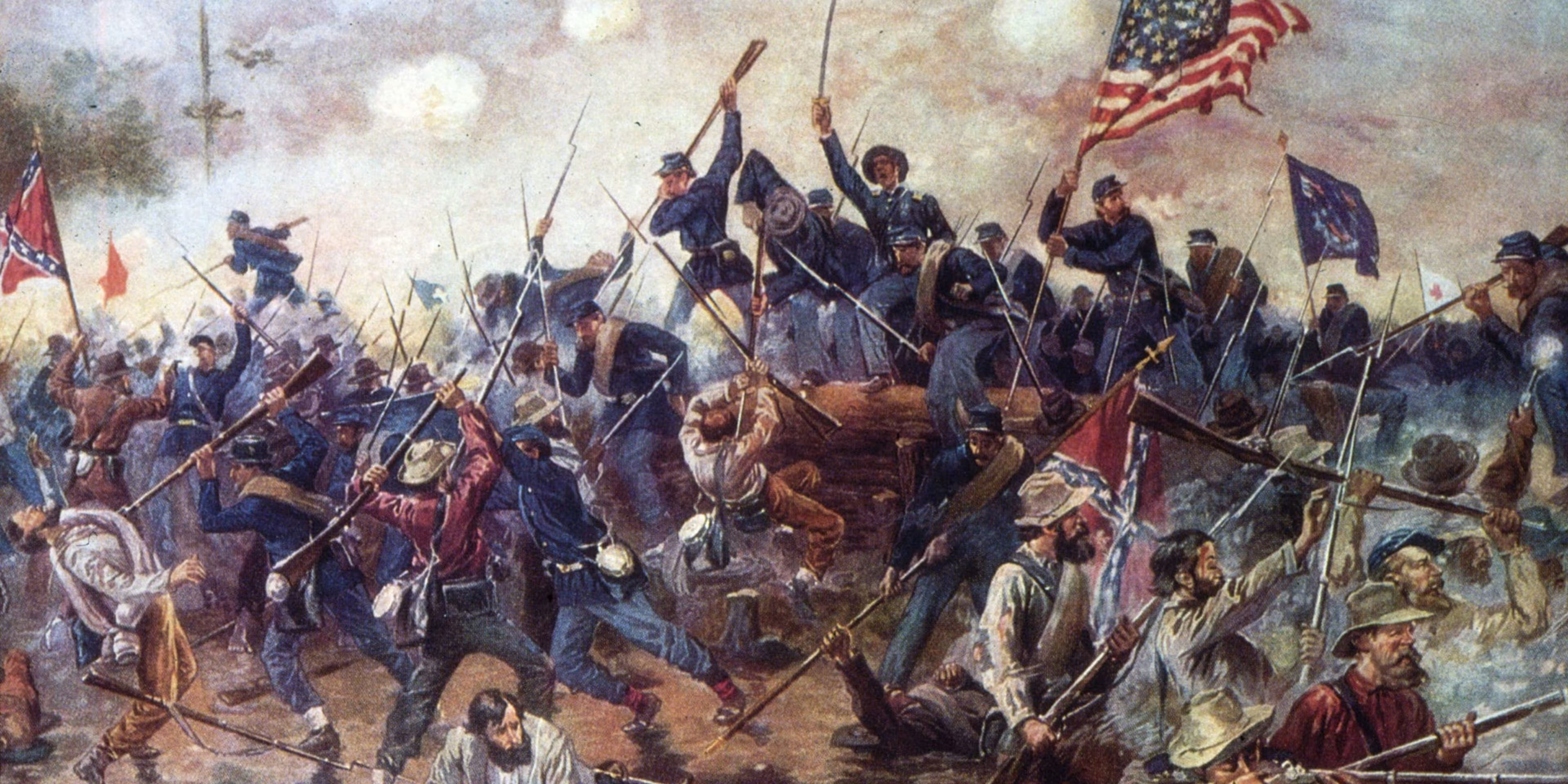
Before diving into scenarios for a modern conflict, it’s important to appreciate just how different today’s America is from 1861. The American Civil War (1861–1865) was fundamentally a regional war between an alliance of Southern states (the Confederacy) and the federal government supported by Northern states (the Union).
It had clearly defined geographic lines—North vs. South—and the primary cause was an open dispute over states’ rights, slavery, and the fact that Southern states decided to secede from the Union. In this war, armies lined up in uniform, battles were fought with muskets and cannons, and casualties were counted by the thousands in single days of pitched battle. News traveled by telegraph and newspaper, and the war ended with a formal surrender at Appomattox.
Now, fast forward to the 21st century. The United States today is far more populous (over 330 million people vs. around 31 million in 1860) and far more technologically advanced.
Society is deeply interconnected in ways Civil War era Americans simply could not imagine.
Let’s break down a few key differences that would shape any modern civil conflict:
No Neat Geographical Split - Unlike the neatly drawn battle lines of the first Civil War, today’s political and cultural divisions don’t follow clear state borders. Yes, there’s talk of “red states” and “blue states,” but in reality almost every state is a purple patchwork of urban, suburban, and rural divides. In 1860, the Confederacy could literally draw a line on the map. In a hypothetical civil war now, the front lines would be blurred and everywhere. It might be neighbor against neighbor in many communities. As historians have noted, even states viewed as solidly red or blue have “deep internal divisions” as the split isn’t North vs. South anymore, but more like metro areas vs. rural areas, coasts vs. interior, and people of different ideologies mixed together nationwide. The Mason-Dixon Line would be a historical footnote; a modern conflict might instead see something like urban centers in conflict with surrounding rural counties. In other words, America’s next civil war (let’s pray there isn’t one) wouldn’t have convenient maps with colored regions—it would be a crazy quilt of conflict zones.
Different Causes and Ideologies - The original Civil War was fought primarily over one monumental issue: the enslavement of Black Americans (though also wrapped in the language of states’ rights and union vs. secession). A modern civil war, if it broke out, would likely stem from a confluence of many tensions: political polarization, cultural clashes, racial and religious resentments, economic inequality, and disputes over government power. Instead of a single, clear cause, it would be the result of accumulated grievances exploding. Both sides (if “sides” can even be clearly defined) might see the other as an existential threat to their America. Importantly, many Americans today lack a consensus on what the core dispute even is—disagreements range from gun rights, abortion, immigration, to election legitimacy and beyond. That makes a modern conflict more chaotic in purpose, perhaps more akin to an ideological free for all than the focused issue of 1861. As a bit of dark humor: in the 1860s they argued over the Constitution and slavery; in a 2020s civil war, folks might be ready to shoot each other over Twitter arguments and pandemic policies.
Technology and Warfare - This is not your great great grandfather’s war. The weaponry and technology available now are light years beyond bayonets and cavalry. In a modern civil war, one side’s “cavalry charge” could be a fleet of armed drones whirring overhead, and their version of the telegraph is a viral social media post rallying supporters in real time. Advanced firearms are widespread among the U.S. population—everything from AR15 style rifles to stockpiles of ammunition in private hands—not to mention the firepower of the U.S. military itself (tanks, jets, precision guided missiles, you name it). Cyber warfare would be a game changer: hackers could attack power grids, communication networks, banking systems, etc., potentially causing chaos without a single shot fired. And unlike the slower communications of the 1860s, today news (and misinformation) travels instantaneously via the internet. A rumor or propaganda piece can incite a mob in hours or minutes across the country, whereas in the 19th century, you had to wait for the newspaper or a guy on a horse. To put it humorously, during the first Civil War, “going viral” was more about a dysentery outbreak than a social media post—in a second civil war, unfortunately both could happen (just imagine trending hashtags alongside actual battles… grim, but distinctly modern).
The Role of the Federal Government - In the 1860s, the federal government was relatively small and the country was loosely governed by today’s standards. Now, the federal government’s presence is everywhere—from the interstate highway system to the FBI, from social security checks to satellites in space. Washington, D.C. isn’t some distant idea; it’s a force woven through everyone’s daily life. This means any rebellion or conflict today faces a much stronger central authority (with a huge budget and powerful agencies) than the Confederacy did. It also means a modern civil war would disrupt daily life for citizens immediately, as everything from mail delivery to electricity could be affected if the center fractures. In short, the stakes for societal collapse are much higher because so much of our infrastructure and economy rests on peace and centralized order.
Diversity of Society - 21st century America is far more diverse in race, ethnicity, and culture than the America of the 1860s. This diversity means the fault lines of conflict aren’t as simple as North white vs. South white (with Black Americans tragically caught in between as in the first war). Today’s potential factions could be defined by complex identities and alliances—for example, conflicts might pit extremist factions (of various ideologies) against what they see as an oppressive system, or even multiple factions against each other. There could be white nationalists, militant anti-government groups, and even some far left revolutionary cells, all with very different visions. And millions of Americans of all races and backgrounds would be caught in the middle wanting no part of violence. The first Civil War was devastating, but at least the two governments (Union and Confederacy) could negotiate a formal end. A modern conflict with decentralized groups might be much harder to resolve or even pin down—you can’t exactly have everyone meet at a single surrender ceremony if dozens of militant cells are operating independently.
In summary, a second American civil war would be a messy, modern beast that shares only the name “civil war” with its 19th century predecessor. It would be less Gettysburg and more guerrilla warfare; less formal secession and more societal collapse. Now, with those differences in mind, let’s explore the scenarios of how such a conflict might play out—from the most likely form it would take to the absolutely worst case, nightmare scenario.
Brace yourself, because this gets intense. I’ll try to keep a sense of humor where I can, because otherwise we’d all be sobbing into our coffee mugs by the end.
III. Fault Lines and Factions: Who Would Fight and Why?